

By Stephen Hall
Bald Eagles mate for life and use the same nest every year to raise their eaglets. Bald Eagle
nests are the largest in the avian world, and like ambitious homeowners, eagles tend to add to
the size of their nests every year, adding up to a couple of feet in depth and width, which adds
to the insulative properties of the nest. Male eagles gather and deliver the sticks, grass and
moss to the females, who do most of the actual construction and organization.
There is an eagle’s nest in St. Petersburg, Florida that tips its overburdened branches at about
three tons! There is a nest in Ohio that has been used continuously for 34 years, and while bald
eagles live on average 20 to 30 years, it appears that nests are sometimes passed down to
offspring who have reached mating age just when their parents have stopped using the nest.
Having said that, successfully fledged eaglets stay in their parents’ territories for about two
months, still pestering their parents for food, before striking out on their own, and later
discovering in subsequent years, that they are not welcome back to Mom and Dad’s territory.
Quoting myself from a previous article, “the number of breeding pairs of bald eagles in the
lower forty-eight states crashed in the late sixties to just over 400 pairs, due to hunting, habitat
destruction and most prominently, the use of chemical pesticides in agriculture, such as DDT.

In a scary process, known as “biomagnification”, bald eagles, being an apex predator at the top on
their food chain, and feeding mainly on fish, occasional small rodents and carrion, in other
words, wildlife which had themselves absorbed toxins in various forms ultimately from lead
bullets, pesticide-laden vegetation or runoff from agricultural fields, suffer highly concentrated,
elevated levels of these toxins, negatively impacting birth and mortality rates. Calcium
deficiencies caused by the toxins resulted in the thinning of eggshells, which would collapse
under the nesting female’s weight, causing a nosedive in successful eaglet births.
The Endangered Species Act of 1973 was the result of the attention called to these and related
problems by wildlife lovers, falconers, hunters and others concerned about the fate of our
native species. With the banning of the pesticides most harmful to wildlife in the United States,
eagle numbers recovered, with the result that the bald eagle went from “endangered” to
“threatened”, and to finally “delisted” in 2007, as mating pairs reached over 11,000 in the lower
forty-eight. Eagles were never as threatened in Alaska and British Columbia, and Alaska still has
about 80% of the world’s bald eagles. Many raptors joined in the recovery, due to the banning
of these pesticides, most notably, the peregrine falcon.”
Bald eagles attain mating age at about five years old, and because eagles will molt out their
seven thousand feathers through Spring, Summer and Fall, it is done in a gradual one-at-a-time
manner, which does not affect their ability to fly, and over this period the head and tail feathers
gradually come in white. The white head and tail of a bald eagle is a sign to other eagles that
the eagle has reached mating age. When friends and neighbors tell me they’ve seen a golden
eagle in the Adirondacks, while that is possible, they’ve usually seen an immature or “juvie” bald eagle, whose body feathers generally over time grow in from a deep brown to a lighter brown.
Fledging eagles lack the more mature flight muscles their parents have developed, and Nature
compensates by growing them larger flight feathers, which aids in gliding and lift. This is why
around the time of fledging, juvies appear larger than their parents, even though the parents
are heavier.

Fledging, actually trying to fly for the first time, doesn’t always work, and an eaglet may flutter
down to the ground, in which case the parents may try to feed them on the ground, until
further growth gives the juvie strength to take off, or the eaglet figures out how to climb back
up to the nest, which may be 50 to 150 feet up the tree, a system that works until the fledge
successfully flies, or a predator shows up, and ends the process.
Starvation tends to be the number one killer of wildlife, including eagles, and eagles lead fairly
spartan lives. After year one, female eagles may lay up to four eggs, while the average is two,
and not all eaglets survive. When you have a litter of kittens or puppies, they’re all born within
minutes of each other, after which the relative dominance of the individual sorts out the
pecking order.
It may be two to five days between a female eagle laying her first egg and her second. This
means that the first hatched, largest eaglet may dominate its younger sibling, including
snatching food from the beaks of Mom and Dad, sometimes starving a younger sibling, or even
kicking the smaller sibling out of the nest to ensure receiving more food from the parents.
Unlike higher mammals like gray wolves, out of which we gradually bred dogs, eagles don’t
strike me as terribly attentive parents. They present the food to the eaglets grasping beaks, but
don’t seem to favor younger, weaker eaglets, even at times favoring the strongest member of
the clutch.
With most birds and mammals, males are larger than females, but with birds of prey, the
females are generally larger than the males. Male bald eagles average seven to ten pounds,
while females range from eight to fourteen pounds. There are many theories why females tend
to be larger, but not much agreement.
My theory on weight disparity is that females spend more time on the nest keeping the eggs
warm, while the males are probably more efficient hunters, being lighter and faster. But this
means when a nest is attacked, a large female will be better able to successfully drive off
predators, and those that survive attacks are generally larger, and pass along those genes to
their female offspring. In the Adirondacks, threats to eagle nests are fishers, racoons, ravens,
great horned owls, and rarely, other eagles. Birds of prey are what is left of Theropod
dinosaurs, so when you see a red-tailed hawk, think Velociraptor, the star of the endless Jurassic
Park versions.
I’ve lived on the West Branch of the Ausable River for 25 years, and with my late wife, Wendy,
owned and operated the Adirondack Wildlife Refuge, where we combined wildlife
rehabilitation and release with educating the public about wildlife, to raise donations to fund
our operations.
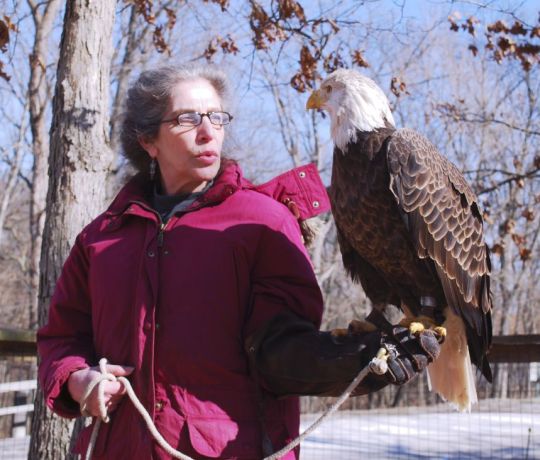
We rehabbed and released many bald eagles over the years. We usually had two or three bald
eagles at a time, whose injuries prevented releasing them, as they would have been unable to
make a living in the wild. These are the eagles the public would meet, and three of the eagles
who lived at the Refuge are still down in Dollywood, a terrific family park in the Great Smokies.
Our home is right on the river, that section called “Lake Everest” (honoring an important
Wilmington historical figure) because of its lake-like features, and I can generally see clearly
what is going on, from kayakers in Summer to snowshoers and cross-country skiers in Winter.
In years past, we would run our gray wolves on the river in Winter, and neighbors on the river
would gather on their decks to see the wolves go by. The only experience in my life that is more
beautiful than the Adirondacks in Winter is the Adirondacks in Autumn, with Spring and
Summer not far behind, this from a guy whose favorite places include Alaska and the Great
Bear Rain Forest of B.C.
My Wendy passed away in January of 2022, battling the ravages of organ cancer in home
hospice. Three months before her passing, I spotted a snowy owl on a white pine across the
river, and with camera in hand, rushed outside to see what was going on. To my surprise, I
realized the owl was being attacked by a bald eagle, and after the eagle let the owl escape, I
saw for the first time that there was another eagle, and they were building a nest in a dead
spruce tree, against the stunning backdrop of Whiteface Mountain, Esther (another of the High
Peaks) and Marble Mountain.
I was so excited, I raced in to tell Wendy, but she had become so weak and bed-ridden at this
stage, I couldn’t help her outside to witness this miracle of Nature. All she could do was smile,
and say, in effect, “how perfect is this”? Wendy believed in reincarnation, and while I’m more
of a science-oriented guy – show me the evidence – Wendy and many of her friends told me
that mother eagle was just the next stage of Wendy’s life.
What is haunting about this belief, is that the eagles, in choosing an unsuitable tree, had chosen
a tree that could be clearly observed from many angles, at any time, and in a tree where any
kayaker or canoer can clearly see the nest, but can’t approach it. I usually follow the rule that a
naturalist can report what they’ve seen, but generally will not compromise the wildlife, by
telling folks where to find it, but this example seems like an exception to that rule.

Eagle nests in the Adirondacks tend to be constructed in white pines, the best lumber tree in the northeast, a strong tree that lives hundreds of years. We have many of these trees in the 50 acres of the Wildlife Refuge, and there’s a line of them up and down the west side of the river on other privately owned lands. These trees are subjected to the strong storms and winds coming down off Whiteface and the other peaks, so I was both puzzled and surprised to see the eagles building in a dead tree, which surely will be toppled at some point by the winds and weather, leaving the parents back at square one, without a nest. Speaking of irrational behavior, I ran down to the river, shouting, “not that tree… that one”, pointing to one of the white pines.
My own impression is that eagles tend to glare at us, as though we’re some sort of curiosity, not worth paying much attention to… and they continued building their nest in the dead spruce. Three months later, just days after the mother of My children and the Love of My Life died, they settled into the nest. Mother eagle laid a single egg, and Dad kept flying up and down the area of the frozen river, looking for small mammals and birds to bring back to the nest.
Based on where I would see other eagles, I estimated that my eagles had a territory of about ten square miles. Eagles in Winter often scavenge roadkill and the remains of other hunter kills, the latter being why lead poisoning is still a most common fatality in eagles. Ask your hunter friends to switch from lead to copper bullets, to help spare scavenging wildlife.
The male eagle still had the markings of a juvie, and I suspected that the female’s mate may have been killed or died, and the female accepted having this not-quite-ready-for-prime-time male as her new companion. By a year later, the male displayed all the markings of an adult, though we still playfully called the female a “cradle robber.” Some Adirondack eagles, like osprey, head for open water, say, east to the Atlantic, in Winter, while most are pretty much around all year, so they’re able to feed themselves, even during the harsh Adirondack winter.
The way Nature works with eagles, a female will lay a single egg in its first year of mating, almost as though Nature is saying, “Let’s see how this goes”, and if successful, the egg will be laid about early February in the Adirondacks, and hatch about 30 days later. The eaglet will be weak and clunky looking, as their beak and talons, two weapons upon which the eagle will depend, grow at a faster rate than the puny body, which has downy feathers for warmth, and will develop thicker downy feathers, followed by contour and body feathers which include flight feathers. Dad will bring prey to the nest, and Mom will hold the food in such a way the eaglet can rip chunks off, the eaglet growing quickly, eventually “fledging”, trying its first flight in another twelve weeks.
As Spring settles in, the rapidly growing eaglets are big enough to stay warm, burrowing down
into the nest, and increasingly, Mom will spend as much time out hunting as Dad, the process
improved by the warming of the air and the melting of the ice. Brown trout go after mayflies
and other insects, which are hatched as larva in the water, and have incredibly short life spans
as adults, maybe a couple of days. Brown trout also eat crustaceans and smaller fish, including
smaller trout. This explains why, starting in late April, early May, we see the expanding circular
rings left by the trout rising to grab insects at the surface, which may bring the osprey and eagle
down to grab the fish.
We’ve all seen those incredible photographs of osprey flying with not one, but two fish, one in
each set of talons. The eagles are arguably the prettiest of the raptors, but it is claimed that Ben
Franklin, my favorite founding father, dismissed eagles as birds “of low moral character”, thanks to their habit of stealing fish from osprey. We had an osprey nest on our east side of the
river for many years, but after our eagles moved in, the osprey left.
This is the third year for our eagles, who have become local celebrities. The first Season, Spring
of 2022, we believe Mama eagle laid one egg, but the eaglet disappeared in mid-May, probably
the victim of a great horned owl I’d observed watching the nest. It always surprises me that owls are celebrated in children’s stories as being kind and wise, when in reality, owls are stone cold killers. This one probably waited for both Mom and Dad eagle to go hunting, and then struck. The last two years, Mom started with two eaglets, but only one survived in each year. The current eaglet is close to flying, so he’ll probably survive.
So…. Why did the eagles choose this improbable tree for their nest? Sloughs are backwaters along the river, where the river backs up during flood stage, particularly when winter snows melt and after heavy rains. The nest looks down upon a slough, which a local beaver I’ve known for years, had dammed, with the result that the slough is about a foot higher than the river, which averages four to eight feet deep along its mile long section, ending in the Wilmington Dam, whose last major reconstruction was built by the CCC in 1938, during the years of the Great Depression and pre WWII.
Wilmington is a 200-year-old town, rich in history, from grist milling to distillation of Whiskey,
lumber and today, principally tourism, and a great place to visit and live. I’ve often joked that
rich folks go to “Lake Placebo” to pretend they’re in the wilderness, while we residents of
Wilmington live in the wilderness, or, as one poster had it: “Whiteface Mountain – See it from
Lake Placid, Play on it Wilmington.”
On the Wildlife Refuge itself, there are several sloughs along the east side of the river. The Eagle slough is much shallower than the river, giving the eagles a great view of any fish or other
prospective prey found in the slough.
The irony of the nest location is that many folks enjoy looking at the nest and following the activity of the eagles from their kayaks, or from the eastern bank of the river on my property, and the eagles themselves appear to be indifferent to the presence of people.
All photos by Stephen Hall.
Thank you for sharing this. My knowledge of bald eagles has increased sevenfold. I’m sorry for your loss.
Interesting article. Is there a way it could be re-formatted for easier reading?
Thank you, Steve. Such fine witnessing, writing, experience. And what an equally fine picture of your Wendy and eagle.
Thanks Dave.
What an amazing read, and fine example of the great things we humans can do (or undo) when we acknowledge the importance of our stewardship and respect for the natural world. I hope we don’t lose the gains we’ve made by villainizing those who seek to maintain this balance, and that we hold to account those we elect to protect our lands, resources and people.
Magnificent. Thanks so much for this wonderfully deep and detailed recounting of eagle life. Unforgettable