

By Jeff Macharyas, Paul Smith’s College Director of Communications
According to Tuscarora historian Rick Hill, the Adirondack region was a Dish with One Spoon: The Dish With One Spoon reference in the Haudenosaunee Great Law of Peace expressly mandates conserving the game roaming about in the hunting grounds, as well as requiring its sharing and contains a promise to share equally in the harvests of the fields.
Before the 19th century, the wilderness was viewed as desolate and forbidding. As Romanticism developed in the United States, the view of wilderness became more positive, as seen in the writings of James Fenimore Cooper, John Muir, Henry David Thoreau and Ralph Waldo Emerson.
In 1868, land surveyor Verplanck Colvin raised the alarm about the depletion of Adirondack resources and in 1873 he recommended the creation of a state forest preserve covering the Adirondack region.
In 1884, continuing impoverishment of the Adirondack’s resources for private gain led the Legislature to appoint a four-member Commission, headed by Harvard University botanist Charles Sprague Sargent. The Legislature authorized the Sargent Commission to investigate the need for forest preservation in New York State. They recommended preserving and protecting State wildlands in the Adirondacks and the creation of a State forestry agency.
The Blue Line
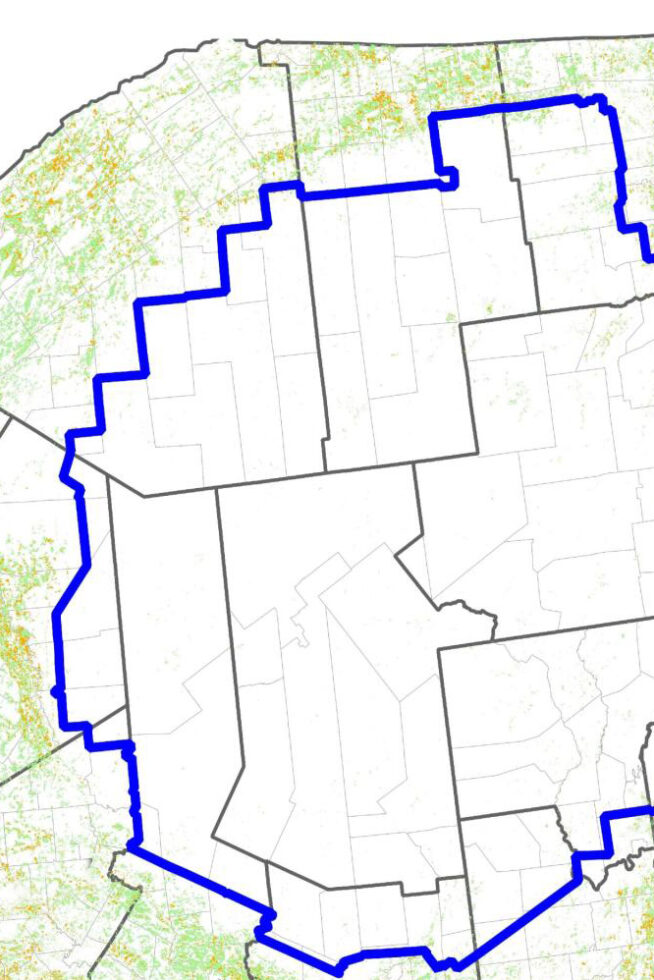
The Sargent Commission’s work led to a series of maps based on surveys headed by Colvin.
Governor David B. Hill signed the law, on May 15, 1885, creating the Adirondack and Catskill Forest Preserves. The law required that all state lands in eleven Adirondack and three Catskill counties “be forever kept as wild forest lands.” This law also authorized the creation of a new Forest Commission to administer the law.
The Forest Commission created two more maps; the first shows forest preserve areas outlined in red, and the proposed park outlined in blue. The second shows a slightly different park proposal outlined in blue.
Use of a “blue line” to depict the proposed park boundary was the genesis of the term “Blue Line.”
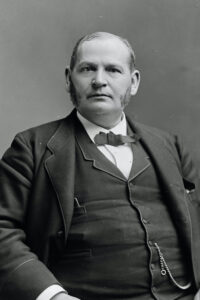
On May 20, 1892, New York Governor Roswell P. Flower (Lake Flower in Saranac Lake is named for him) established the Adirondack Park for “the free use of all the people for their health and pleasure,” and for watershed protection.
Great Camps, Hotels, and One Special College
The 1849 publication of Joel Tyler Headley’s Adirondack; or, Life in the Woods triggered the development of hotels and stage coach lines.
By 1875, there were more than two hundred hotels in the Adirondacks including Apollos “Paul” Smith’s Hotel (1859-1930), one of the first wilderness resorts in Adirondacks, it was, in its day, the most fashionable of the many great Adirondack hotels, patronized by presidents Grover Cleveland, Theodore Roosevelt and Calvin Coolidge. The site of Paul Smith’s hotel would later become what it is today: Paul Smith’s College: The College of the Adirondacks. Although the donation of money and surrounding land for the College was made in 1937, the College would not officially open until 1946, when the first class of 150 students entered to study forestry and resort management.
Editor’s note: This story was originally shared on the Paul Smith’s College website on May 20. Photos courtesy of the author/Paul Smith’s College.
Jeff Macharyas account offers a lot of the basics that will help people understand why the Adirondacks are what they are, and very special to so many people.
If you dig deeper, I would suggest that much of the success of Apollos Smith was built on these basics:
* Marrying Lydia, who we never give equal billing to, for the business and culinary skills she brought to their union (sorry ladies).
* Location, location, location, to quote the realtors mantra. The Adirondacks was transitioning from resource exploitation to being a desirable destination where rich, elite “sports” of that era could go fo hunt, fish and relax in the company of innkeepers like Paul Smith who took good care of them while at the hotel.
* Adirondack guides – The hotel also provided local guides who watched over their rich clients, kept them safe, and entertained them with stories around the campfire. Guiding grew into a cottage industry that helped sustain Adirondack communities and allowed them to grow.
The Paul Smith’s College that I attended (class of *63), always seemed like a shotgun marriage between the “hotelies” and the “grubby foresters”. It makes a lot more sense when you consider the history…
Louis Curth, I was 4 in 1963 and lived at several locations at Paul Smith’s including White Pine. How interesting the history of this place is to me now that I have the time to reflect. Mary Siau
Re: Paul Smith’s/White Pine Camp:
Thanks Mary for your reply, and yes, I do remember your dad on campus, looking very spiffy in his bow tie. He was just one of the colorful mix of faculty and staff who helped we students learn ,and perhaps grow up, during their time at Paul Smith’s College.
As for White Pine, my forestry classmates and I were billeted off campus, out at White Pine Camp, during our final year. We were left pretty much all by ourselves out there, except for the married couple who fed us
. None of us really appreciated how special it was to be living in such a historical and beautiful place. Looking back, it was truly an amazing time, and perhaps it helped many of us learn the basics about how communities are formed from the ground up..
I remember poking around in the main camp, amazed by the small bowling alley. We lived in one of the caretaker houses up the road.