

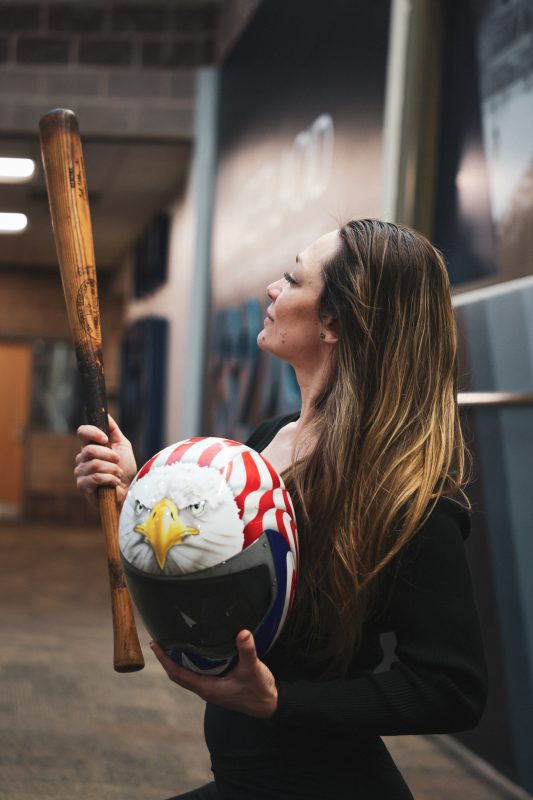
April 6- The Olympic Training Center in Lake Placid brings thousands of athletes to the Adirondacks. But how much do we ever really know about the individual or their lives? Circumstances allowed me to interview renowned skeleton racer Katie Uhlaender, who, with five Olympics behind her, is training for Milano-Cortina Italy in 2026.
Katie doesn’t spend her time reminiscing about her five previous Olympics: 2006 (Italy), 2010 (Vancouver), 2014 (Russia), 2018 (South Korea ) and 2022 (China). She’s older than many Olympic athletes, but Katie is not ready to quit either the sport or a lifestyle that she describes at times chaotic. When racing, she’s lying face down on a small sled, with her face just inches above an icy track, all the while steering with her body. The time to reach the finish line is the only thing that matters, winning or losing a medal by only hundredths of seconds. Sometimes, Katie moves as fast as 89 miles mph on a curved tube of ice or, as Katie calls it, a “cookie sheet with rails,” banging off a wall with nothing for protection but a helmet and a thin, skin tight suit. (Katie Uhlaender knows the thrill of the Olympics, and the frustration with those who run them, Adam Kilgore, February 11, 2022.)
Skeleton racing is a solitary sport, with teammates sometimes competing against each other. But Katie is all about supporting her teammates and women athletes in general. She is proud of the path of athletics she took very early on, and believes that women should be free to choose what is best for themselves. Her career has led to the opportunity to meet athletes from around the world, the exhilaration of Olympic opening ceremonies and travel in general. Her Olympic standing also led her to a position on the crew for seven seasons of Survivor, visiting the Cook Islands, Palau, and Fiji.
Only a few minutes into our meeting at the Olympic Training Center in Lake Placid, I realized that Katie was like no one else I had ever interviewed. I admitted to her I wasn’t sure I was the right person to be asking questions, having so little background in competitive sports. But while Katie was in the middle of competing in World Cup skeleton racing trials the following week, and on a recovery day, she was respectful, engaged and generous with her time. She directed me to the HBO documentary The Weight of Gold, co-produced by Michael Phelps, a 23-Olympic gold medal winner, to better understand the life of many Olympic athletes.

The documentary about mental health challenges of Olympic athletes is an eye opener. Katie is among those interviewed, and who disclose the paradox of having one’s self-worth measured solely by an event that might last only a few minutes. You are either a winner at the Olympics, or you disappear from public view. And even for those who are lucky to be a gold or silver medal winner, their value as a person does not last long. This can be damaging to the athlete’s deepest held belief about his or her identity.
She also shared in the documentary the experience of finding her good friend Steven Holcomb, in his room sometime after his sudden death at the Olympic Training Center in 2017. Katie’s mother, Karen Uhlaender believes that it was after Steven’s death that her daughter started to take her own needs re mental health counseling as an important component of training, considering the stresses and demands of competition. Katie is now an advocate for such, and in an August 2020 opinion piece she writes,
“The current sporting culture that values results over individual well-being undoubtedly correlates with an increase in athlete suicides. Athletes are increasingly speaking out about their loss of identity and sense of hopelessness after performing, a phenomenon that some refer to as post-Olympic depression. The rollercoaster of emotions that an athlete endures both during their competitive years and post careers cannot be overlooked.“
Katie has been agile and athletic all her life. Her mother Karen remembers that Katie was already trying to take running steps at the age of nine months, and was always competitive. Karen told me how Katie was not satisfied with playing girl’s softball in highschool, and encouraged by her mother, Katie was the first girl to play baseball like her father. Katie also played basketball, track and field, volleyball, cross country, golf and powerlifting. While still in high school, living on her own in Colorado and supporting herself, busing tables and teaching skiing and snowboarding, fate took its course. She was observing a young woman working out at the sports center where she sometimes coached, and asked if she could race her in a sprint. Sara Sprung’s response was something to the effect of “ and who are you?” Not only did they become friends, but Sara, already a bobsledder, told Katie about the sport of Olympic skeleton racing.

Katie took the bait and in early 2003, she showed up at the Olympic Training Center in Lake Placid. Not long after she won gold in Lake Placid and was qualified to compete in the Junior World Championship in Germany. She was only 18 at the time, without a passport, and she had to purchase a raceworthy sled. She was a newcomer who had just won a national competition, and was not immune to the sentiment of some that maybe she did not deserve to be there. Katie shared her uncertainty with her father Ted Uhlaender (now deceased.) He recounted his own experience as a young athlete playing at Yankee Stadium, and told her that what she needed to do was to keep her eyes on the ball and to not allow self doubt or the opinion of others to distract her. It’s something that has stayed with Katie these past 20+ years. It was only a few years later that Katie took gold at the 2006-2007 Skeleton World Cup and Sixth in the Skeleton Women Olympic Games 2006 Torino, Italy.
Katie’s life these days in some way, is not much different than for her father. Baseball required his being away from the family nine months of the year. Katie does not own her own home and is often traveling. She has explained to me that behind the hype of the Olympics is a tough reality and many Olympic athletes are living at or near the poverty level. While finances for Katie have always been up and down, and income from athletics has at times been very positive, there is always some level of uncertainty. But she’s traveled around the world, an opportunity she might not otherwise have had, including the wonderful memories of the 2006 Olympics and traveling to Venice, Paris and Milan.
And it’s a sport that can take its toll on her health. Along the way, Katie has shattered her knee more than once, has had three hip injuries, as well as the occasional drama that exists in most workplaces, but sometimes even more extreme. For example, in 2009, at a time when Katie was competing in the World Cup, her father who had been ill, died suddenly. Katie was not present. It’s something that made her question whether she wanted to continue the life that puts competition in front of family and personal needs.
That being said, although she’s now over 40, she plans to compete if she’s eligible in the 2026 Olympics in Italy. In 2014 she was a bronze winner and then not, when controversy about performance-enhancing drugs resulted in the stripping and then reinstatement of the Bronze to a Russian athlete. Katie testified to Congress on July 25, 2018, in support of the Rodchenkov Anti-Doping Act, which was signed into law on December 4, 2020. In her testimony she related that her father, who was a Major League Baseball player, was presented with the opportunity to take performance-enhancing drugs and told Katie his response was, “If you’re at your best, it’s enough. “
The law itself can be found at 21 USC 2402, and provides that “It shall be unlawful for any person, other than an athlete, to knowingly carry into effect, attempt to carry into effect, or conspire with any other person to carry into effect a scheme in commerce to influence by use of a prohibited substance or prohibited method any major international sports competition.”
There have already been prosecutions pursuant to this law, and the first individual charged with violating the law was sentenced in February 2024 to three months prison. Eric Lira was accused of providing banned performance enhancing drugs to competitors prior to the Tokyo Olympics.
When I asked Katie whether she thought that athletes might be reluctant to attend the 2028 Los Angeles Olympics due to international uncertainties, she quickly pointed out that athletes went to China during a global pandemic to compete!
To learn more about Katie or to follow her career: Instagram account: KateU11 TikTok: KateU11 Twitter: Katieu11, Facebook: Katie Uhlaender or visit the IBSF | International Bobsleigh & Skeleton Federation ibsf.org
Photo at top: Katie Uhlaender, April 5, 2025 Photo by Sofie Fachin.
Simply fantastic piece of writing/reporting about a unique female athlete.
Hopefully we will see Katie in the next Olympics.
A very different side of life in the Adirondacks!
Thanks.