

For decades the Adirondack Park State Land Master Plan (APSLMP) has required that State Land Unit Management Plans “will address, on a site specific basis the identification, in intensive use, historic and appropriate portions of wild forest areas accessible by motor vehicles, of measures that can be taken to improve access to and enjoyment of these lands, and associated structures and improvements, by persons with disabilities.”
Wilderness areas are left off this UMP requirement because the prohibition on use of motor vehicles applies to people of all abilities and is fundamental to Wilderness definitions, legal guidelines, and preserving wilderness values.
Now, APA is proposing to delete the above requirement and replace it with a requirement that UMPs will address “the identification of management actions to improve access to and enjoyment of the unit’s lands and waters by persons with disabilities,” inclusive of motorized access and irrespective of how the Forest Preserve unit is classified.
Motorized access for persons with disabilities in classified Wilderness areas (and Primitive and Canoe areas) would, for the first time, become conforming with the Master Plan if the APA’s proposed amendments are approved by the APA members and by the governor.
More than 30 years having passed since the Americans with Disabilities Act (ADA, in 1990), it was plainly appropriate for the APA to incorporate the ADA into the APSLMP including “an inventory of existing structures and improvements that are consistent with the applicable federal accessibility standards for buildings, sites, and outdoor recreation facilities.”
It was also appropriate to incorporate this: “In keeping with ADA Title II regulations on mobility devices, wheelchairs are allowed on state lands anywhere that pedestrian access is permitted.” Wilderness advocates recognize this addition to the APSLMP is overdue and reflective of federal ADA law and rules. Wheelchairs are actual and legal extensions of our feet.
However, it is not appropriate for APA to fumble its legal responsibilities for the Master Plan when it comes to addressing ever-changing power-driven mobile technology, in particular the use of “other power-driven mobility devices” on Forest Preserve. OPDMD, ranging widely in size, weight, power, speed, and impacts, are not wheelchairs. Some OPDMD are designed or modified for persons with disabilities, others may look and operate as golf carts or all-terrain vehicles.
This APSLMP amendment proposes to exempt all classes of OPDMD from the Motor Vehicle definition. Since all motor vehicles are currently prohibited in Wilderness, the exemption for OPDMD means that power-driven devices of all types and sizes may soon be conforming with APSLMP and authorized to enter Wilderness areas. This would be a serious weakening of the State Land Master Plan and, constitutionally, very questionable .
ADA rules require state and local governments to allow people with disabilities to use any OPDMD to enter premises, facilities, including trails unless a particular type of device cannot be accommodated because of legitimate safety requirements. Other factors in the ADA rules are to be used in analyzing where OPDMD may operate in parks and wild spaces. Overall, The ADA requires that each service, program and activity offered by state agencies be made accessible to and usable by persons with disabilities, unless doing so would result in a fundamental alteration of the nature of the service, program or activity.
Prohibiting motor vehicles in Wilderness and wherever such use would adversely impact the ’‘forever wild” preserve is central to the Master Plan’s Forest Preserve program. Allowing all classes of power-driven mobility devices into all areas of the Forest Preserve would be a fundamental alteration of our Forest Preserve. That is precisely what our public environmental agency for the Adirondack Park, the APA, is proposing to do: fundamentally alter Wilderness protection.
Did APA staff share with their voting members and the public written legal requirements, potential impacts to Wilderness areas, and alternative courses of action which adhere to both ADA rules and Wilderness guidelines?
Did the board ask the staff to prepare written narrative that would inform them about how best to comply with the ADA while preserving the Master Plan’s integrity?
Did the APA staff or board ask the DEC if the department plans to sponsor non-motorized programs to facilitate persons with disabilities to experience Wilderness conditions?
Did APA ask DEC if it had prepared policy for the use of power-driven mobility devices, policy that would address what types of OPDMD in what State Lands, describe actual safety and resource protection concerns, and helpfully guide persons with disabilities through the process without any need to amend the Master Plan?
APA asked none of these questions and did none of these things.
Instead, without any written rationale APA staff introduced and, with the support of voting Members, sent to public comment major APSLMP amendments which weaken the Master Plan severely – and did so in a single, hour-long Agency presentation in September. Following the presentation, there was no discussion and no debate from voting Members about the fact that APA staff propose to cede its authority over the Master Plan to DEC by:
- exempting OPDMD from the Motor Vehicle definition,
- making such motorized devices legally conforming uses in all Forest Preserve including Wilderness, and
- authorizing DEC to use its discretion to allow OPDMD on a case-by-case basis anywhere DEC chooses.
APA staff’s only rationale was in a power point presentation which made the astounding claim that the existing Master Plan “pigeonholes accessible opportunities into certain land classifications, and therefore is not reflective of the spirit of the ADA.”
The Master Plan constrains motorized accessibility to the Forest Preserve as required by Article XIV of the State Constitution. The Master plan does not pigeonhole non-mechanized forms of physical access at all.
APA staff seem content to compromise their half-century long responsibilities for Wilderness protection under the Master Plan without the need to do so. DEC, in defending these proposals, offers Wilderness advocates this: trust us to make the right decisions. Hopefully, following public comment (which closed on Dec. 2) in early 2025 APA Members will debate the matter squarely, stand behind the Master Plan, and refuse to cede their responsibilities for the APSLMP to DEC.
The APA staff power point included these false assumptions: first, it assumes that accessible opportunities must be mechanized or motorized to be in the spirit of the ADA – not at all true; second, it assumes that the Master Plan’s 52-year-old restrictions on motorized uses in Wilderness, Primitive, and Canoe areas violate the spirit of the ADA, again not at all true as pointed out by Janet Zeller, a person with disabilities and the former National Accessibility Program Manager for the U.S. Forest Service.
Ms. Zeller wrote the following concerning the National Wilderness Preservation System, but her article applies equally to state-run Wilderness systems inclusive of New York’s Forest Preserve:
“The National Wilderness Preservation System (NWPS) ensures an opportunity for challenge, solitude, and self-renewal for each person who is willing to make the effort it will take to pursue those goals. Through the Wilderness Act we all have the right, regardless of ability, to enjoy a wilderness experience in an area untrammeled by modern motorized and mechanized civilization. The effort it takes each of us to visit a Wilderness area is an essential part of this experience. People with a wide range of significant disabilities value their right to that same opportunity to challenge themselves and, thereby, to gain the unique experience wilderness offers, either on their own or with the assistance of family or friends.”
Ms. Zeller’s article goes on:
“There are devices that might make it easier for a person who has some limitations to their ability to walk long distances or over rough ground. However, the use of such mechanized devices would go beyond the minimum necessary requirement. A study by Lais et al. (1992) confirmed that the vast majority of people who have disabilities are not seeking to expand mechanized use to make access to Wilderness areas easier. Wilderness is not about what is easy, wilderness is about “solitude or a primitive and unconfined type of recreation,” as stated in the Wilderness Act, and the challenge it takes in order to experience those outcomes. If a person is seeking easier access, there are a wide range of other federally managed lands to choose from where motor vehicles are allowed, and yet the look and feel of the area may be the same as in the NWPS. The result of adhering to that tightly written ADA legal direction within the NWPS, and other areas not designated for motor vehicle use, is that the person who is dependent on a mobility device for locomotion is not denied the opportunity to enter those areas, and can do so without impinging on the challenge, solitude, and self-renewal that wilderness offers to each person seeking that more difficult NWPS recreational opportunity. People with disabilities go to wilderness for the same variety of reasons as do people without disabilities, including to challenge themselves.”
To repeat, the U.S. Justice Department is not forcing the APA to exempt OPDMD from the Master Plan’s Motor Vehicle definition or to weaken its Wilderness guidelines; nor, I believe, are persons with disabilities, many of whom have no desire to invade Wilderness with engines since doing so would erode the very thing they have a right to experience on the same terms as more able-bodied individuals – Wilderness conditions where nature holds the reigns, not human convenience or motorized conveyance. I will argue that the APA and DEC appear disrespectful of persons with disabilities by assuming their sole interest and means to experience areas classified Wilderness is with a motor vehicle.
(Janet Zeller’s quotes are taken from her article “Wilderness and Accessibility,” International Journal of Wilderness, April 2008, Volume 14, No. 1.)
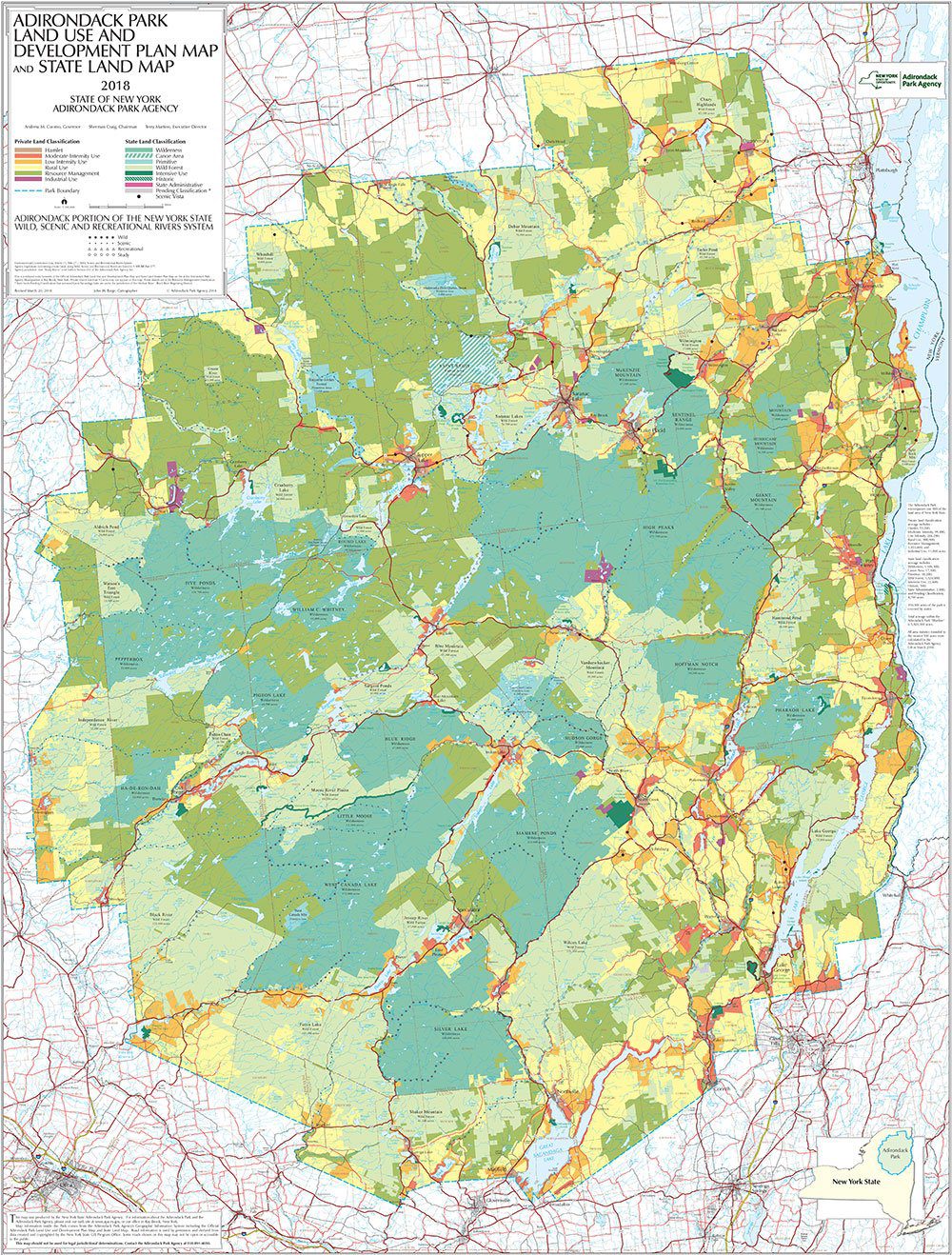
Photo at top: APLUDP Map 2018. Photo provided by David Gibson.
Great article and explanation!
Riding an ATV or other powered vehicle including snowmobiles, or running a motorboat in ADK canoe areas is not a “wilderness experience”. If you are so disabled that that is the only way you can go there, you have my sympathy but I have reached an age where there are lots of wilderness experiences I cannot experience either. Making it possible to drive an ATV in the High Peaks would ruin the sense of wilderness far more than the use of drones which are prohibited there.
1.Wilderness experience???? People need to realize that this is this is a working park with people who live here. This so called experience can be enjoyed in most places of state owned land in the Adirondacks. The forever wild clause has been hijacked by the green lobby and it’s time for residents of this so called park to fight back. 1.Future land acquisitions should be brought to vote to the people of that municipality 2. No more land added to the Forest Perserve. Classify it as something else. 3. Maybe now is the time for municipality’s to come together and look for a way to gain control of our our lands and dissolve the park. If it has come to the point where people are are not allowed to enjoy the lands because people are mad because a golf cart looks like a atv it’s time to reel it in
Shawn,
1. Municipalities DO have a say on if/how new lands are added to the Forest Preserve. Remember the back-door bargaining that went on during the Boreas Pond acquisition? Much was already determined between the Towns and NYS before the general public had any input.
2. This makes sense, but getting residents across the state to agree to an acquistion that they can’t control or access via APA/Forest Preserve is going to be a hard sell. Yes, you can open land sales up to private entities, but many people aren’t keen on foreign land investment/speculation either within the current Blue Line, so how do municipalities/residents control how the land will be used?
3. Dissolving the Park has been an option since Article 14 was introduced. While a small number of NYS citizens have been against it since inception, I don’t see enough serious legal opposition to the Park to get far toward dissolution. But maybe someday.
Boreas, I agree with you on point 3. But I do see a lot more opposition to the APA now than just the kind of folks who didn’t like the idea at the start. Like I said it seems like their main opposition now comes from groups that used to support them?
Some good points you make 1. Correct municipalities do have a say in purchases but that doesn’t mean they are really be listening to. I feel the towns want to keep roads on the new purchase for more than just walking.on. Most have had heavy industry on the for generations and the state just shits it off. 2. As far as how the municipality’s control how the land will be used one need to look no further to the the neighboring towns that are outside of the blue line. The town of Edwards is no different than the town of Fine. They manage although I find the amount of state owned land in Edwards and Russel is used as buffer around the line. 3. Maybe with new judges on the Supreme Court towns in the park may have better footing for legal action
Even the so called environmental groups are describing the APA and the DEC as doing such a terrible job maybe we should give it back to the towns?
Glad to hear the red tape bureaucrats are keeping busy
Thanks for this clear and insightful article, including the issues raised by Janet Zeller. She writes, “If a person is seeking easier access, there are a wide range of other federally managed lands to choose from where motor vehicles are allowed, and yet the look and feel of the area may be the same as in the NWPS.” Our forest preserve lands in the Park offer a wide range to choose from without modifying the Master Plan to allow motor vehicles in areas classified as Wilderness.
The Adirondack Forest Preserve is a tremendous resource in the Northeast, within a few hours drive of tens of millions of people, offering increasingly rare opportunities for wilderness experience. Slightly more than half (1.3 million acres), is classified as Wild Forest, in a carefully calibrated classification system, where motorized equipment may be used by people with disabilities. Those opportunities are developed through the Unit Management Process to provide optimum experience and environmental impact. This proposed amendment would throw out the accumulated decades of Forest Preserve planning and simply permit motorized access in Wilderness areas without regard to whether it is suitable.
Mr Gibson is correct in his analysis of the issues although his unfortunate propensity for long winded writing does not help the cause.
Sorry David but others are more concise and manage to make their point.
I write this as a registered nurse who took care of people with developmental disabilities in the Adirondack Park for 35 years.
Mr Gibsons article is clear, concise, intelligent, honest, caring, and necessary. It also displays an integrity and thoughtfulness not displayed in certain comments about it.
“Death by a Thousand Cuts”….Bravo to David Gibson………..
This is the important part I think.
“The Master Plan constrains motorized accessibility to the Forest Preserve as required by Article XIV of the State Constitution.”
The question now with where the ADA is… Is this constraint legal under federal law?
The state is trying to do the best they can here to keep this very limited, it’s not some conspiracy to open up wilderness to lots of motorized use. I know and have known lots of people in the DEC and they care deeply about preserving wilderness in the adirondacks. They are not the bad guys portrayed in some of these articles.
Also, an earlier article was describing the fact this is what the DEC is already doing. The give out very few TRP’s to allow the OPDMD’s to be used in forest preserve areas. We are not talking about ATV’s or UTV’s or any such thing. They would never give a permit for something like that in a wilderness area.