

A week at NASA
NASA scientists can track plankton blooms across the ocean and, thanks to a satellite launched about a year ago, drill down into the specific species dominating a particular bloom.
PACE (Plankton, Aerosol, Cloud and ocean Ecosystem) is an active NASA mission focused primarily on marine systems, cloud formation and the tiny particles, dust storms and pollutants transiting the planet.
As the satellite differentiates types of microscopic marine life, scientists can detect and classify large blooms moving through the ocean’s complex currents. The data will help researchers study how plankton communities are responding to changes in ocean temperatures, nutrients and sunlight and how they interact with fish communities.
It can also detect harmful algal blooms, though likely not at the scale of most Adirondack lakes.
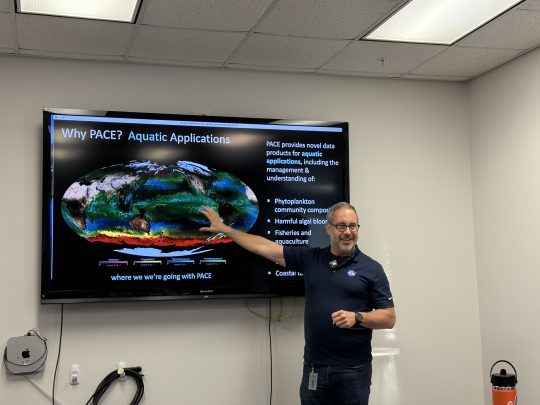
I recently spent a week at NASA’s Goddard Space Flight Center outside Washington D.C. with a team of others focused on climate change communication in the Adirondacks. (More to come on that.)
It was a crash course in the mind-boggling science conducted on a sprawling campus in suburban D.C. We peeked inside the control rooms for satellite missions like Landsat, which powers Google Maps and other daily references, and saw the agency’s next space telescope under construction in a clean room protected by a literal wall of HEPA filters.
The Nancy Grace Roman Space Telescope, named for NASA’s first chief of astronomy and first female executive, is a wide-field telescope intended to detect billions of faraway stars and planets while probing the origins of the universe.
Built in Rochester, the telescope’s optical telescope assembly (the large mirror in the bottom of the picture on top) was delivered to Goddard in early November — the project’s last major delivery. The telescope is scheduled to be launched to a Sun-Earth orbit near year by May 2027.
In the Adirondacks, scientists already rely on NASA-enabled remote sensing to examine landscape changes, forest carbon storage and, increasingly, the health of the region’s thousands of lakes. As part of the planned SCALE survey, researchers at the City University of New York Graduate Center are using Landsat and other satellite data to measure changes to water temperature, lake color, snow cover and more.
The NASA visit last week was part of the agency’s Earth to Sky program, which aims to connect more audiences to NASA science. The Adirondack Explorer joined a regional Adirondacks team that also includes the Wild Center, Paul Smith’s College and the Adirondack Research Consortium.
We will now be organizing a regional training focused on bolstering climate science communication. Expect to hear more about that next year.
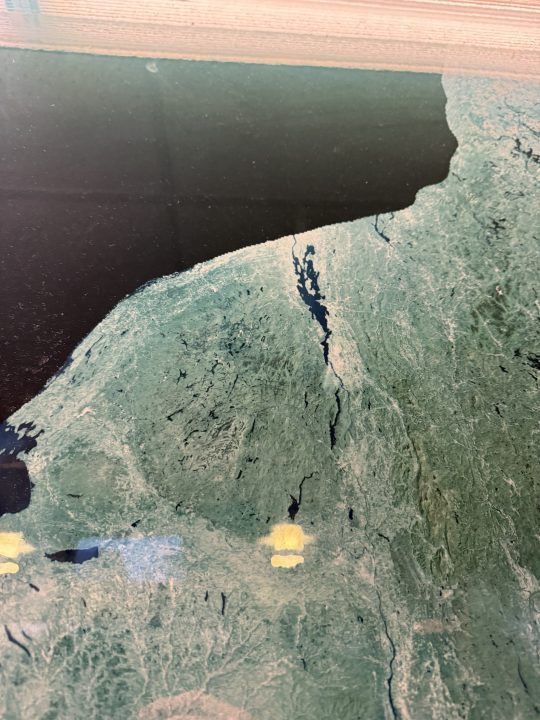
Top photo: The Nancy Grace Roman Space Telescope under constriction in a clean room at NASA’s Goddard Space Flight Center in Greenbelt, Maryland. Photo by Zachary Matson.
This first appeared in Zach’s weekly “Water Line” newsletter. Click here to sign up.