
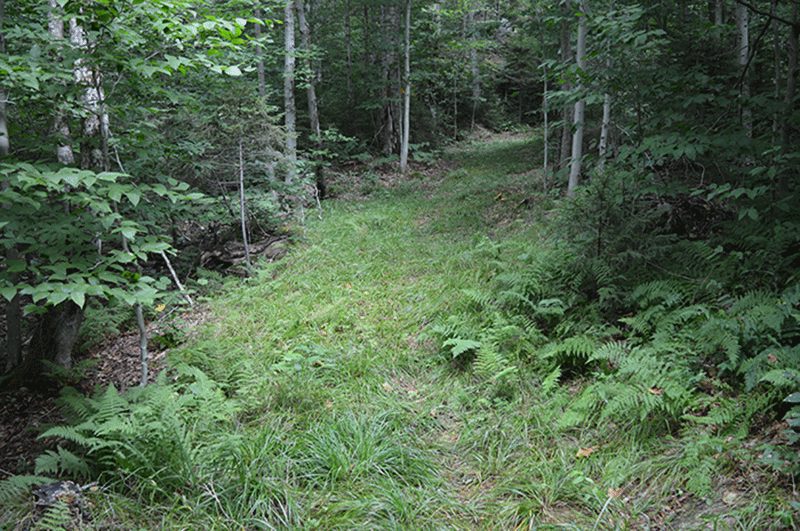
The Department of Environmental Conservation (DEC) and Adirondack Park Agency (APA) are poised to once again violate Article 14, Section 1, the famed “Forever Wild” clause, of the New York Constitution by proposing new snowmobile trail standards that are patently unlawful. In 2021, the New York State Court of Appeals, the state’s highest court, struck down plans by DEC and APA to build hundreds of miles of Class II Community Connector snowmobile trails (see photo above), finding that the extra-wide trails requiring wide cleared corridors that were flattened and graded with heavy machinery and the destruction of tens of thousands of trees violated the Forever Wild clause. See Protect the Adirondacks v. DEC, 37 NY3d 73, 77 (2021).
Remarkably, the agencies have recently proposed “new” snowmobile trail standards that incorporate many of the features that were rejected by the Court of Appeals as unconstitutional.
The unconstitutional Class II trails were authorized under a 2009 joint DEC-APA “Management Guidance” policy that allowed the trails to be built to a width of 9-12 feet. The policy contained two major loopholes that shaped how Class II trails were built. The first loophole authorized “limited” use of heavy machinery for grading trail surfaces flat, but in practice heavy machinery was used to grade the trails from end to end. The second loophole allowed “bench cuts,” the graded and tapered areas above and below a wide trail cut into the side of slope, to extend well outside the 9-12-foot trail width area. Since bench cuts were not counted as part of the trail width, this resulted in widespread tree cutting and terrain grading well beyond a 12-foot-wide trail corridor and in many instances Class II trail corridors were constructed 20 feet wide and wider.
The State’s highest court rejected these excessive trails widths, terrain changes, and tree cutting when it found Class II trails to be unconstitutional. The Court of Appeals came to this conclusion because DEC’s “plan requires the cutting and removal of thousands of trees, grading and leveling, and the removal of rocks and other natural components from the Forest Preserve to create snowmobile paths that are nine to 12 feet in width.”
DEC-APA had been stopped from building new Class II trails with injunctions and restraining orders during the legal battle from 2017 to 2021, and in the wake of the Court of Appeals decision, the DEC Commissioner rescinded the snowmobile trail construction and maintenance “Guidance” that had sanctioned the Class II trails. In its place, the DEC stated that it would go back to an old snowmobile policy called Office of Natural Resources-2 Snowmobile Trails (ONR-2) from the late 1990s to guide its snowmobile trail construction and maintenance.
ONR-2 allows what’s called a “Class A” snowmobile trail, which can be constructed and maintained to a width of 8-12 feet. Apparently in DEC’s mind, all the agency has to do to comply with Forever Wild clause and the Court of Appeals’ decision is to shave one foot off of the trail width minimum while maintaining the other Class II trail features. This approach is sure to fail a constitutional analysis.
The Court of Appeals found that trails that are nine feet wide with “sharp curves, steep slopes, and bridges, where a 12-foot width is allowed – the same width as an interstate highway lane and enough to accommodate two SUVs, side-to-side” was unconstitutional. Class A trails under ONR-2 may be one foot narrower in some places but still allow at their maximum “a 12-foot width” on all “sharp curves, steep slopes, and bridges,” and are essentially identical to the trail dimensions found to be unconstitutional.
Even more troubling is that ONR-2 doesn’t address bench cuts, the trail building practice that requires extensive terrain changes outside the trail corridor. The Court of Appeals specifically noted how bench cuts can change the character of a snowmobile trail corridor, stating that “bench cuts – cuts into sloped ground and removal of the cut soil, rock and trees to create a ‘bench’ upon which a trail can be placed – require clearing the land on the up- and down-slopes of the trail, resulting in the clearing of the forest floor up to 20 feet in width in certain areas – a span wide enough to site a two-car garage.”
ONR-2 is also outdated because it only recognizes trees that enjoy constitutional protections at a size of 3 inches DBH (diameter at breast height), whereas the 2021 Court decision recognized a tree as a tree at 1” DBH. DEC’s new Forest Preserve Work Plan policy (CP-78) requires counting of all trees 1” DBH or greater during management activities, so ONR-2 does not even conform with DEC’s own Forest Preserve policy.
In the wake of the 2021 Court of Appeals decision that found that DEC and APA had violated the Forever Wild clause, the agencies formed the Forest Preserve Trails Stewardship Working Group to revise and upgrade trail management and design standards. This group has been working for nearly three years, and includes members from local government, trail building groups, and environmental groups in both the Adirondack and Catskill parks. Protect the Adirondacks participates in this group. The Working Group’s main success to date was helping to develop the new Work Plan policy (CP-78), which sets out DEC policy for how new projects on Forest Preserve lands, such as the construction and maintenance of trails, campsites, bridges, trailhead kiosks and parking lots, are to be planned, reviewed and undertaken.
As part of the Working Group efforts, DEC-APA staff prepared draft “trail design parameters” for hiking trails, bicycle trails, snowmobile trails, cross-country ski trails, and horse trails. The Working Group reviewed these drafts and provided written comments and additional comments at group meetings. The trail design standards are accompanied by a new draft “Forest Preserve Trails Guidance” that sets out policy and management objectives for the trail standards. DEC aims to bring both drafts to the APA this fall for review and then hold public hearings and a public comment period.
The Trail Design Standards with the biggest problems are the Snowmobile Design Standards. DEC-APA are proposing snowmobile trail standards nearly identical to those found by the Court of Appeals to be unconstitutional. Protect the Adirondacks, and a number of other Working Group participants, have urged DEC-APA to revise the proposed snowmobile standards to ensure conformity with Article 14, but at this point the state agencies seem determined to once again force a constitutional showdown.
This decision by the DEC-APA is simply not rational or responsible public policy. It’s difficult to express how disappointing it is that after the 2021 Court of Appeals decision ruling that the construction of Class II trails violated Article 14, these agencies are planning to basically build the same type of constitutionally impermissible snowmobile trail.
At the last meeting of the Trails Stewardship Working Group in September 2024, DEC-APA staff stated that they plan to base their new draft Snowmobile Trail Design Standards on the outdated and unconstitutional ONR-2. They stubbornly asserted that ONR-2 complies with the State constitution. They also stated that they had not contemplated how bench cut widths will be managed under the new Forest Preserve Trails Guidance or Snowmobile Design Trail Parameters. That is a major oversight indeed.
The new Forest Preserve Trails Guidance must comply with Article 14. The new snowmobile trail design standards must also comply with Article 14. That the DEC-APA are planning to effectively thumb their noses at the Forever Wild clause is a sad chapter in the history of New York’s two leading environmental agencies.
Protect the Adirondacks and others have urged the DEC-APA to change course and to get on the right side of Forever Wild in their management of the Forest Preserve. We won’t know about their decision until they present the new policy and trail standards to the APA this fall. This will be followed by a public hearing and public comment period where we will rally New Yorkers to stand up for the Forever Wild Forest Preserve.
Photo at top provided by Peter Bauer.
Is it going to be illegal for me to camp within 150 feet of a new snowmobile trail that will have been illegally cut through Forever Wild forest? Once I have set up my camp and illegally cut down a standing dead tree (just to fire up a discussion), am I going to be fined by a ranger patrolling the forever wild forest on an illegal snowmobile trail that makes my camp illegal.
Don’t camp without counsel.
I’ll hire the Adirondack Counsel.
Oh come on Peter! Can’t you accept the trade-off of 65,000 acres of new Forest Preserve for a few miles of new snowmobile trails. That’s the largest addition to the Forest Preserve in many years, but Town Boards will not likely approve any more similar additions when/if the next major private owner of timberlands decides to sell out.
Much of the Whitney land could now be on the market, but I seriously doubt any town would approve a purchase by the state given the problems you’ve caused with this snowmobile suit.
And with regard to tree cutting in general on the Forest Preserve, remember that many state campgrounds were built without any constitutional amendment. Many trees were cut, the terrain was altered, and some of the roads were paved. This allowed many citizens of the state, who had paid for this land, enjoyed it and hopefully become advocates of that land.
Despite all of that “insult” to Forever Wild, the basic principle has survived. I believe the basic principle of Forever Wild will easily survive this new snowmobile plan while also making more people favorable to protecting the Adirondacks.
That well has been severely poisoned.
Oh how true. Thanks to Mr. Bauer and the green religious cult lawsuit the towns, villages and counties within the blue line that got screwed over will never buy into any trade offer ever again. And that message has spread like wildfire throughout the park.
Good points Tony. As a wilderness paddler I’d happily give some snowmobile trails to see the Whitney estate or the likes added to the current wilderness. It’s about balanced use, not wilderness or nothing.
Thank goodness voters have the ability to amend the constitution to avoid having their will usurped.
Certain groups would prefer we park at Woodgate and walk into the mountains.
Agreed. Snowmobile tourism is one of the greatest economic engines for native Adirondackers in the winter season. Certain groups would be glad if we just left our family homes, our businesses, our way of life and just cede it all to the wealthy eco-warriors.
The Forest Preserve wasn’t established with the intent of providing places for joy riding on machines. These trails in Wild Forest areas should be designed to respect the intent of the Forest Preserve, by minimizing cutting and land alteration.
Thanks Richard. People have to stop being so selfish and think about future generations too.
The Forest Preserve was established in part for preserving the Adirondacks for recreation. The intent was never to lock it up so tight that it could not be used. Joy machines back in those days were boats or (or horses). If they didn’t want any mechanized access they would have put that in Article 14. I doubt the voting public would have gone along with such a prohibition.
A popular trail near me has just been improved for hikers by the addition of several wooden walkways i.e. bridges and and the creation of walkways by moving hundreds of rocks and adding non-native gravel so hikers don’t have to rock hop or get there boots muddy. That certainly degraded the Forever Wild wilderness experience but it’s OK because it was for hikers. There is a big double standard here.
If you don’t like hiking on snowmobile trails be cause it ruins your “wilderness experience,” stay off them, but don’t begrudge a very large recreational group that contributes greatly to the Adirondack economy the 0.037% of Forest Preserve they use as snowmobile trails.
To imply that a rough mostly 9 foot cleared path through the woods is the same as an interstate lane or that 2 ATVs could safely pass on such a trail (if they were even allowed in the Adirondacks, which they are not) is a gross misrepresentation.
“The Forest Preserve was established in part for preserving the Adirondacks for recreation. The intent was never to lock it up so tight that it could not be used.”
Absurdist statements never help an argument – they only inflame the rhetoric. If the taxpayers and voters truly believe the way you do, you should have no trouble amending the Constitution to allow whatever type of access you desire. Until then, both the letter and spirit of Art. 14 should stand.
The Court of Appeals found that trails that are nine feet wide with “sharp curves, steep slopes, and bridges, where a 12-foot width is allowed – the same width as an interstate highway lane and enough to accommodate two SUVs, side-to-side” was unconstitutional. Class A trails under ONR-2 may be one foot narrower in some places but still allow at their maximum “a 12-foot width” on all “sharp curves, steep slopes, and bridges,” and are essentially identical to the trail dimensions found to be unconstitutional.
Compared to the snowmobile trails on private land, snowmobile trails on Forest Preserve are much narrower and demand slower speeds due to the curves and the need to carefully pass other snowmobiles. I have spoken to snowmobilers who call Forest Preserve snowmobile trails “goat tracks” and therefore not as easy to ride with current models of snowmobiles as the private land trails. I’m definitely in favor of retaining the current standards of width, curvature, and bridge width. These trail standards require that any grooming be done with a snowmobile rather than a large tracked vehicle along with regulating speed. Nevertheless, these trails do permit town to town snowmobiling to the economic benefit of the towns.
The old school trails are not what drives business via snowmachine tourism. Is it worth investing in trails that are less appealing to the target audience than offerings found outside of the Park boundaries? Will “goat paths” be popular with riders on expensive modern machines?
Great points!
Would these improvements benefit mountain bikers as well? That is a demographic that Phil said in another article here is rapidly growing. I have biked on some snowmobile trails over the years it’s kind of a pain when you gotta carry across a brook. A bridge is probably better for the trail from an environmental perspective. Especially the ones you can ride through the stream. I don’t really care either way. Snowmobile trail mileage is capped so maybe it isn’t really worth worrying about. Seems like only the motorized users get stuck with these restrictions. Lakes they can’t go on, caps on mileage, ATVs can’t even be used legally on FP land, etc. Like Tony says, maybe we should cut them some slack here. But I am certain there will be additional legal actions pursued.
The intent of the laws involved clearly indicate that snowmobiles would be allowed on wild forest land. That has not changed or been challenged. Like any technology these machines have evolved over time. Trails should be allowed that make it safe as possible for this use. Things change you have to adapt. I am not a snowmobiler but I will take advantage of these types of trails for cross country skiing if they are allowed. These are almost akin to what we see as ski trails in scandinavia. Amend the constitution if necessary.
Amend as the voters allow. That’s not the issue. The issue is the DEC and APA have chosen a route that clearly violates recent court rulings and the state constitution. They should not be allowed to do that.
Of course that is what the courts are for, and I am sure it will get back there. I was just suggesting that if Peter is correct, and at this point it is only folks opinions, then you might need an amendment. Just because someone writes a story on a website doesn’t make it fact. Far from it…
I tend to agree that an amendment could be required and useful to have the ability to adapt the forest to newer technologies with snowmobiles. OTOH, it’s likely a lost cause as climate change is seeing less snow and warmer temperatures that is killing the snowmobile tourist business. The local private auto repair guy I use is also a bigtime snowmobile participant. He has for a few years abandoned the Adirondacks in favor of northeast Quebec and northern Maine, where snow conditions are still OK for the activity. He said he hasn’t gone to Old Forge in years and I suspect that’s the future.
Peter,
DEC is so corrupt that I have uncovered two documented cases of Region 5 surveyors producing survey maps and subsequent tax map revisions moving state land boundaries for private interests.
Currently, Stony Creek tax map has Lot 270.-1-2 moved 700’ (about 40 acres) onto state lands existing since 1900.
They were caught and it is being reversed. You took sides with this large landowner and primary shareholder in the Livingston Lake Club that this change would have benefited.
What is driving this and why, i.e., who still snowmobiles? Given the recent winters, my area is littered with snowmobiles on trailers for sale that no one wants to buy to use three days a year. In five years, snowmobiles go the way of pay phones. So why the big push to violate the state constitution to benefit a dying hobby?
Washington State has had rapidly declining numbers of snowmachine registrations the past several years and will be reducing the number of Sno-Parks dedicated to snowmachines this winter. Is this a national trend? Will motorized winter recreation provide a stable long-term boost to rural economies? Is it worth building infrastructure to support an activity increasingly impacted by warmer winter?
HMMMM…????
It’s interesting I wonder how a snowmobile is defined in these regulations. I sometimes see these things on the lake in the summer these days, I can see them evolving to not need snow, or to operate with and w/o snow (more of an all terrain vehicle, wink. wink..)
The title of this article is very provocative, “Aim to violate”. It seems like many environmental groups have joined forces with private landowners to revile regulatory agencies like the DEC and APA. Good to see people coming together…
I can see groups that support ATV use (that one does appear to be growing rapidly) working with the DEC to replace snowmobile use on snowmobile trails like they did with snowmobile groups and local officials like they did when the APA act was passed allowing this motorized use.
Interesting story on it here:
https://www.newyorkalmanack.com/2021/02/how-snowmobilers-won-their-special-privileges-to-ride-on-forever-wild-lands/
Yes – great article. I very much miss John Warren’s writings here in the Almanac.
But it’s okay to build bridges and nail signs into trees so hikers don’t get lost. Take down the bridges,signs and remove the lean-tos. Forever wild should be forever wild for everyone.
Do you realize how many trees don’t have signs? Have you ever been lost in the Adirondack mountains?
I agree 100%.
Typical double standard practices. If landowners cut brush along a small stream they are stopped. I know of a residence within the Adirondack park that is a mess with junk cars and a lot of debris around biiuldings with nothing being done. It is disappointing to all state taxpayers to watch some of the mismanagement goes on. Keep the forever wild, “forever wild!” Once the poor practices begin, it’s
“Forever gone”….
Yes. But this is the government. They’re here to help. Lol!!
Everyone stop crying. FML! A snowmobile trail will hurt nothing. Animals get used to the comings and goings of humans. Restrict the use of stupid racing exhausts, impose speed limitations governed by our employees, the cops on sleds and boom. Everyone is happy aside from the yuppies that don’t belong here from Jersey and such
Thank you Peter for forcing Almanack readers to confront what our precious “Forever Wild” clause really should mean to them.
But also, and perhaps even more importantly, what will this precious remnant of America’s once abundant wildlands mean to our future generations of young people? The choices we are making NOW will in many ways shape the future of the Adirondacks for better or worse.
We are clearly VERY schizophrenic in our natural resource decision-making. We don’t have the political will to insist on real and lasting accountability at the APA and DEC, and saddest of all, upon our elected leaders, who we continue to vote for – even though they blatantly lie to us, and sell us out for the dark money of special interests!
If, and when, we face up to our political indifference, we might have a chance to resolve some problems that would be in the best interests of the Adirondacks – both now and in the future.
A good start would be to vote NOW and elect good people to work for US!
Yes, most everyone knows that by the letter of the State constitution, the forever wild provision stymies motorized recreational activities in the Park, so good for you Peter, and your minions, for squelching the businesses and communities that rely on winter activities to survive.
Of course, you do-gooders could care less about businesses, and those unable to hike or snowshoe to enjoy the beauty of the Park.
While I can somewhat understand the need to curtail ATV and UTV access to sensitive areas, snowmobiles and grooming equipment do not pose a threat to the landscape and ecosystems. When the forever wild provisions were drawn up, there was no such thing as a snowmobile, hence consideration of their usage in the Park was a non-issue. This is where common sense, and compassion for the starving communities would seem to play, but again, you don’t care about any of it.
Most can only hope that there will be a day when there’s an administration with some common sense and guts to table a constitutional amendment to bring “forever wild” designation into the 21st Century.
Hopefully this will proceed as proposed. It is important that we get people to see and appreciate the woods so that they can be protected longer term. The extremely minor disturbance caused by these trails is overwhelming well worth the larger gain. It has consistently been my experience that when I bring new people into the woods they walk away with a much greater appreciation then before the experience.
Commissioner Wilm had a problem. Rangers were reporting that motor vehicle violations on the forest preserve were increasing. Now political pressure was growing on him to open state land for use by “snowmobiles”.
Then as now, justifications included: these snow machines are low powered (under 25 hp) family & utility machines that will not harm the land or its ecosystems; motorized recreational activities will be good for local businesses; snowmobiles will will get more people out to see and appreciate the woods.
Then as now, some people and organizations were opposed to this new motorized use of forest preserve land, based upon Article 14 of the state constitution (the Forever Wild clause). Their opposition was ignored.
In 1968, rangers (including me) and our trail crew set up camp at Baldwin Spring to lay out and construct the Wilcox Lake snowmobile trail network. In the years that followed, bridges, safety improvements, ranger enforcement trail patrols, and clandestine ad hoc grooming by users all became part of this new wintertime use (and misuse) of forest preserve”forever wild” land.
Can such motorized uses be justified? Or do they violate our state constitution’s “Forever Wild” clause? What does “forever wild” mean to you?
More great points!! Whe one reads the history of that moment in time during the 60s (see John Warren’s article/link above provided by Paul), It becomes clear there was no grand design of networks of high-speed trails throughout the Park. But this is indeed how snowmobiles – for good or ill – made their way into the FP backcountry on backcountry-type trails – which were the only type available to them on FP land.
Various localities improved THEIR Town/County trails to cater to increasing numbers of users to attract more sleds to their area for winter revenue, but they were few and far between. Once Moose River Plains began to be utilized, the slippery slope appeared and was taken advantage of at the expense of the Forever Wild clause and the Constitutional framework of the Park. I feel we need to revisit a Constitutional amendment to continue with any changes to snowmobile usage and trail creation/management. If that is what NYS taxpayers/voters want, then so be it.
The same amendment session could also include motors/trails WRT handicap access and evaluating appropriate hardening/reclassification of heavy use hiking and parking areas. May as well do it all at once.
We need to dump this forever wild crap and get the laws changed to allow more vehicle trails to be opened
Good luck with that…????
Yes, on the trails.
But it is interesting to think about how some things that are not allowed under FW could greatly benefit the Forest Preserve. I think about how things like drones can introduce and educate a whole new group of people who can get there physically on the benefits of conservation. Just look at the “fat bear” thing they do each year in Alaska. This has probably had big benefits for education and perhaps fundraising. The web cams you would need, and allowance of competitive events that are not allowed under forever wild would not allow it in the Forest Preserve. The main gist of article 14, to limit timber removal, have really become this whole different thing that hikers have jumped all over thinking that is mainly to their benefit.
Paul,
Timber removal may have been an underlying reason for the creation of Article 14, but the Amendment was SOLD to voters by providing opportunities for the types of recreation (that existed at the time) and restoring/preserving the wild character of the area. Between over-cutting, erosion, and subsequent fires, it wasn’t strictly all about trees. Water quality and navigation was also a concern. It looked like a war zone.
But I agree Art. 14 should probably be amended to bring it up to date and into the future. But I doubt any administration will have the stomach to debate the issue, let alone accomplish any real change. There just isn’t that much clamor across voters to open the FP to motorized access to a significant degree. So APA/DEC keep trying to gnaw away at the edges and low-hanging fruit, standing on the shoulders of flawed 60s era decisions that never provided the proper Constitutional codification to back them up. Politics is still politics.
The land will not be leased, sold, or exchanged. The timber shall not be sold, removed, or destroyed. Nothing in there about recreation but you probably know better than I on how it was “sold”? For this the issues is the definition of “timber”. There is nothing at all about restrictions on motorized uses in that particular law. The DEC and now the APA and the DEC allow one type of motorized use – snowmobiles. It didn’t take any amendment to article 14 to allow that. Now if Peter’s issue is that that snowmobile use on the FP is a violation of that law, it’s a whole different discussion. Now that I think about it, I don’t see any need or precedent that it would require a complicated amendment to article 14 to allow some of these other uses.
Well, that is why all of these lawsuits are being brought. With each action the DEC/APA tries, there is often nothing in the Constitution specifically enabling or forbidding it. It is a vague document. So essentially, APA/DEC keep throwing spaghetti at the wall in hopes the courts will see it their way and something sticks. Then they have a precedent – for a while.
Dropping Article 14 altogether or adding amendments with specific language are about the only ways to avoid the lawsuits everyone seems to hate. But without amendments requiring voter approval, it is difficult to set any long-term goals or plans for the Park. Instead, differing lobbying groups during each administration causes meandering of policies without a true North Star. It is the VOTERS that should provide that star, not special interests.
Sorry, but I disagree Mr. Mallow with your comment: “We need to dump this forever wild crap and get the laws changed to allow more vehicle trails to be opened.” I think that this is just hyperbole, but it still seems out of place in this discussion.
Our schoolteachers used to explain “hyperbole” as a manner of speaking or writing that makes someone or something sound much bigger, better, smaller, worse, more unusual, etc., than they are.
Sadly, hyperbole seems to be the preferred “coin of the realm” for many influencers, con artists, and politicians who exploit social media venues these days. But here at the Adirondack Almanack too? Granted, that APA and DEC need scrutiny, and even the adequacy of “forever wild” in the Adirondack future could do with a fresh look, however, it is not CRAP!
The use of hyperbole to cover up misinformation and half-truths seems to be growing, and it is making consensus-building and problem-solving in our democracy more and more difficult to achieve. This Is not where we want to be going!
In the current election cycle, unscrupulous political candidates and their silent partners are chipping away at America’s long history of free, fair, and well-run elections. Leaders, who clearly ought to know better, are tolerating outrageous and inflammatory rhetoric in place of intelligent discussion – to the detriment of ALL Americans.
In short, “hyperbole” has become a bait-and-switch dirty trick tool used to cover up candidate misinformation . Clever, attention-grabbing hyperbole is being used to capture media headlines, day after day after day, until voters finally start to believe that fake hyperbole is really the truth!
I’ve visited too many traveling carnivals and heard the fast talking carni-showmen and flim-flam artists use their smooth hyperbole to trick people out of their money or worse. All that glitters is not gold!
How many other non-motorized trail users are out in the winter with the snowmobiles? A very few snowshoers and some XC skiers. If the snowmobile trails did not exist there would be no trails for these users-only vanilla type trails in at XC centers. In the summer the snowmobile trails are weeded over and if you don’t cross or come very close to them you would not know they are there and used in the winter. Do gooders have to realize there are very few jobs in the park not connected to tourism. the communities need the winter money coming in to survive. How many do gooders need to depend on a tourism job to survive/live here? I XC ski on the snowmobile trails. Without these interesting trails I would be limited to the boring golf course. Have noise limits, speed limits, etc. but let them also enjoy the winter woods so others can also.