
By Pete Nelson
The state’s review of its High Peaks Visitor Use Management (VUM) project as a way to manage and protect the High Peaks Wilderness has opened a discussion of “solitude.”
Some say a visitor plan needs to be developed with the expectation that hikers should find solitude on the summits of popular High Peaks like Cascade or Mount Marcy.
That challenges the largely unexamined assumption that access is not in keeping with wilderness preservation. If we allow all those people on Cascade’s summit, the argument goes, we give up wilderness.
That is flat wrong. It falsely places important interests in conflict and does so in a way that causes harm to wilderness and to people who may have a different view of what it means to experience solitude than I do.
I’m a co-founder of a wilderness advocacy group and of an initiative to make the Adirondacks welcoming to everyone.
Solitude is subjective, and its role as a factor in wilderness protection gets even more confused when we conflate it with remoteness, or when we confuse it with protection of the resource.
Solitude is personal. Merriam-Webster calls it “the quality or state of being alone or remote from society.” People can disagree on what “remote from society” and “quality or state of being alone” is.
Does a hiker violate a reasonable definition if they are with a spouse, best friend or children? Is its sanctity lost if Mount Marcy’s summit is shared with a steward and a forest ranger? Most people would say of course not.
To acknowledge that solitude is subjective is not to lessen it. After all, wilderness is a subjective concept too. I don’t even like being on official foot trails with roots, water bars and trail markers. Not everyone feels the same.
A travel and recreation expert speaking at an Adirondack diversity forum challenged the “traditional” idea of wilderness solitude—being alone in the primeval—part of the legacy of 19th century transcendentalists (such as Emerson and Thoreau). She told us that with her Puerto Rican and Dominican cultural values, rooted in rural landscapes, solitude on Cascade’s summit would best be achieved by sharing a reverent, spiritual experience with a few dozen of her closest friends and family. Who’s to say that my version of solitude is better?
Many defenders of Adirondack wilderness would say that solitude’s definition is not so fluid. It is a specific criterion in the formal definition in the Adirondack Park State Land Master Plan (SLMP), the guiding document for management of the forest preserve.
Speaking to the suggestion made in a public VUM meeting that solitude should not be expected on the summit of Mount Marcy, a state official said that the language on solitude in the SLMP “puts us in a bit of a bind.”
However, this tension disappears with a more careful reading of the master plan. The authors referred to solitude but didn’t define it. Wilderness, they said, “has outstanding opportunities for solitude or a primitive and unconfined type of recreation.” The aspirational term “opportunities” clearly does not guarantee wilderness solitude.
The language for the High Peaks Wilderness is even more obvious. It says that outside of the most popular routes, the regularity of human encounters decreases significantly. Opportunities for solitude in a wild and remote landscape are available “for those who seek it out.”
This is an explicit acknowledgment that solitude is not expected on popular summits but must be achievable elsewhere. That’s easy to do: I enjoy solitude in the High Peaks whenever I like.
Another problem with interpreting the meaning of solitude is that it gets conflated with remoteness, which is not the same.
Remoteness can be defined objectively, and it can be measured. It’s rare in the East and it needs to be protected, even increased where possible. One of Adirondack Wilderness Advocates’ major campaigns is to urge the state to measure remoteness in Wilderness, Wild Forest and the park as a whole, to increase the percentage of the Adirondacks that is remote.
The master plan refers to remoteness as it does solitude, even requiring tracts classified as “Wilderness” to be a minimum size or meet other criteria to meet sufficient remoteness.
A few years ago, advocates for wilderness found that barely 5% of the Adirondack Park is more than three miles from a road (the threshold for remoteness used in national parks and forests). Remote land is unquestionably scarce, and it must be protected.
The assumption that my strict version of solitude is more authentic than a version that accepts 30 people on Cascade, and therefore should be the basis for wilderness management decisions, is troubling, even pernicious, as it suggests that some don’t belong in the wilderness.
What doesn’t belong in Adirondack wilderness is an activity that damages its ecology or decreases its remoteness. What does belong is anyone wishing to experience wilderness and helping to keep it whole, regardless of their interpretation of solitude.
We must work to ensure that the state’s evolving wilderness management strategies focus on ecological integrity and protection of a pristine natural environment. The opportunity to experience solitude in the High Peaks, in whatever form, is not at risk.
This first ran in Adirondack Explorer’s Aug/Sept 2024 magazine. Click here to subscribe.
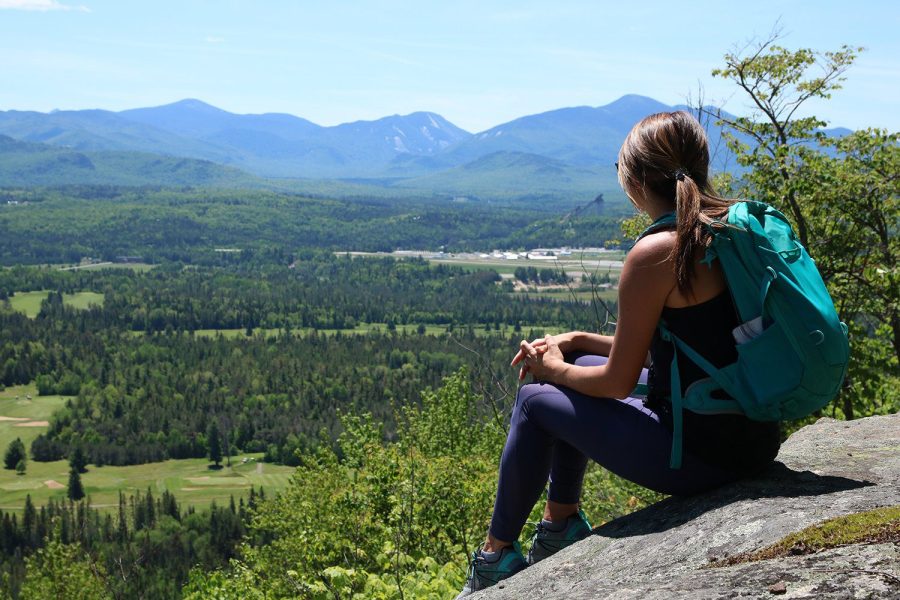
Photo at top: Hiker on Cobble Hill in Lake Placid. Photo Credit: LakePlacid.com (ROOST).
I like it.
Thank you Pete for emphasizing that it is “opportunities” for solitude that the SLMP says must be preserved in Wilderness. As I have noted in previous comments, I once hiked 17 miles in the High Peaks Wilderness and saw not one other person. I didn’t hit any summits, but hiked along an attractive river and passed by a pretty lake. Furthermore, I didn’t encounter a single section of eroded trail. Those opportunities are out there.
As for remoteness, we’ve at least ended DEC personnel driving to Duck Hole or Shattuck Clearing, but obviously we can’t push back the established state, county, or town roads to increase remoteness. Adirondack licensed guide Joe Hackett has noted that, on a calm night at the Duck Hole, one can hear the trucks on Rt. 3 as they accelerate up the hill past Coreys Road. At least one would not likely hear those trucks (or any others for that matter) at Ouluska Lean-to.
You had me up until the last sentence. Still scratchin’ my head…
Having now read this twice, I started thinking about sound. Machine noises bother me in the wilderness: cars, planes, drones. I want to hear only streams, rustling trees, and the occasional animal.
Sometimes I like to hike alone. Other times, with a friend. We, like others I encounter on a trail, can be very chatty but it usually passes.
How about those people who like to hike with loud music? For some, that is their peer group’s “culture”. I’ve been alone on a mountain top when a dozen chattering hikers arrived with a backpack speaker. They considered it normal; I thought it was rude. What if the norm in their culture is to paint graffiti on the rocks- do we accommodate that too?
In my opinion, “Leave no trace” includes excess sound – whether music or overly loud voices. I try to treat our state’s attempt at a “wilderness” setting as a church. Walking softly, quietly, and carefully should be emphasized and disturbance minimized. But I grew up with a different Nature ethic than many users today. I have a reverence for disappearing areas where solitude can still occasionally be found. My generation will be gone soon. Teach your children.
Putting “culture” in quotes gives the point away. Of course loud music and graffiti are inappropriate; I don’t know anyone who thinks otherwise. Boreas is right: reverence for the place is a necessary value. By far the best improvement in management of the High Peaks has been expansion of the steward programs. Teach your children, sure, but teaching everyone about protecting and respecting the wilderness works for me.
As to sound, noise pollution is a tangible and real problem. We’re losing remoteness, and noise is one factor. Reduction of noise impacts is absolutely an important part of wilderness protection.
I remember when I was younger skiing into a remote lake lean-tos to camp for a couple nights knowing I would be the only one there, and trying to fall asleep to the sound of distant snowmobiles on trails/lakes miles away. Not their fault – they were doing nothing illegal. Sound really travels on a cold clear night. I was completely alone – but was I?
Two articles in the September/October 2024 issue (Perspective; Wilderness Protection is the Point, by Pete Nelson, Its Debatable; How Should the State Value High Peaks Solitude by Peter Bauer and Bill Schneider) brought up the issue of solitude and its relationship to wilderness. An interesting German word, waldeinsamkeit, gets at what I think the authors are trying to define. Roughly translated, it means getting a feeling of oneness, connection with, or solitude in the forest. For an interesting online article see: Waldeinsamkeit: Germany’s cherished forest tradition (bbc.com). Interestingly, in Germany and, much of Europe, this feeling of solitude is found, not in extremely wild and remote forests without the visible hand of humans, but in any open space where a person can feel at ease and relaxed without outside interruptions.
I find the concept of waldeinsamkeit to be what I seek when I take a walk in a county park, my friends 20 acre woodlot, or cross country skiing at the local nature center. I drop into a small hemlock stand and absorb the quiet, maybe even startle a deer seeking shelter from the wind. One does not need vast untouched areas to experience this oneness and solitude. I can sit on a stump from a recent timber harvest and marvel at the quietness and solitude. I do not disparage people who desire a more physically remote venue but let’s not insist that such a setting is necessary for waldeinsamkeit. Conversely, as the authors point out, the extremely popular High Peaks of the Adirondacks might not be the place where one should seek solitude. These places are like gazing at Niagara Falls from the edge of the canyon or trekking through Muir Woods just outside San Francisco, very busy and noisy. Instead, find solitude along the less traveled trails and byways across the Adirondacks and the rest of our wonderful State of New York.
This is spot on. Thank you for sharing a different cultural interpretation of solitude that really resonates. I, like Boreas and others, prefer to be completely alone (well, with my spouse). But that is not that only way I find what you describe. I have experienced “waldeinsamkeit” in many other settings and situations, including the summit of Cascade.
Perhaps ‘some’ are actually pushing for enforcing solitude on Mt Marcy and Cascade, but is there a real chance that a universal application of a solitude requirement is ultimately proposed, especially as is correctly pointed out, the ‘opportunities for solitude’ language in the MP should give plenty of cover to avoid that unrealistic recommendation for the VUM?
Hopefully the extreme solitude concept doesn’t become a straw man that prevents any honest discussions regarding visitor numbers to this wonderful place, when crafting the VUM.
This doesn’t have to be “all or nothing”. Simply limiting the numbers on trails will maintain a level of solitude while helping to maintain the natural environment. Building larger parking lots at trailheads seems to go in the opposite direction. We are lucky to have green spaces in New York State. Let’s control the numbers of folks tramping up a trail at a given time and all will still have access, but they may have to choose another day or a less popular trail some of the time.
Two problems. First, nobody can dictate what this limiting number should be in order to meet “solitude.” As Pete Nelson described, there is no definition of solitude. Second, you have a legal issue, as per the NYS Constitution. The lands of the Forest Preserve are public lands
Once again, Pete Nelson hits the nail on the head.
I will add that there are definite, racist, and exclusionary undertones in the traditional, rigid definition of solitude. Years ago, I remember hearing a comment by a caretaker in the AMR saying in effect “those people don’t belong here.” In that case, he was referring to Jews, but the implication of “others” i.e. people different than white Christians is obvious.
Yes, things have improved, but we still have a ways to go.
Pete Nelson packs a lot to think about into this one sentence. “Solitude is subjective, and its role as a factor in wilderness protection gets even more confused when we conflate it with remoteness, or when we confuse it with protection of the resource.”
The importance of preserving as much as we can of the disappearing remnants of our wild places continues to grow in its value to all of us.
Sadly, we are fighting a losing battle against the so-called “progress” of a bloated human population that wants it all and may end up with nothing in the process.
one of my favorite authors, Aldo Leopold, writes a lot on this subject in his book “A Sand County Almanack”. I urge urge everyone to read it. Here is one sample:
“But all conservation of wilderness is self-defeating, for to cherish we must see and fondle, and when enough have seen and fondled, there is no wilderness left to cherish.”
Interesting discussion.
I think this article and some comments allude to a very important point: solitude is indeed subjective. Solitude for thee may very well not be for me as Mr. Goodwin points out with his story but also Mr. Nelson with his example of the Dominican folks. I would also add, someone traveling from Brooklyn for a foray up Giant Mountain will absolutely find solitude on a crowded trail and shoulder to shoulder summit. I’ve lived within the blue line for a long time, because I like solitude. I have never, not even once, climbed a high peak trail. Wouldn’t consider it, doesn’t even cross my mind because that is way beyond the bounds of my idea of solitude. I am very comfortable with folks who derive solitude from combat hiking clumping in places I would never go.
With that said though, the problem comes, when solitudes clash. A group of folks singing and chanting, or blasting music, or letting their dogs or kids run free, etc may be that individual group’s idea of solitude but it certainly infringes on someone else’s. Therefore, limiting the volume of people present at any given time is definitely one very obvious approach to the solitude standard.
A few years ago on my way to the mailbox, I encountered legendary Stillwater Hotel’s owner talking with a couple and child in the parking lot. Marion waived – “Maybe Jim will take you out in his boat to see some loons”. They just been to a wedding in Syracuse and were planning to drive to Niagara Falls before returning home to Italy. I asked, “What brought you here?” They replied, “The map shows very few roads here. No matter where we hike in the Alps, we come to a road.”
The next day we hiked to an outcrop overlooking the reservoir with the High Peaks in the distance. Little Gaia exclaimed the
view in Italian, “Neverland”!
Experiencing the fulfillment of isolation is a purely unique and personal experience. ‘Seek and ye shall find.’
Very good article. If you are seeking solitude, it might be best not to go to the summit of Cascade! There are another three million acres out there that few people actually experience. People are concentrated on the waterways and High Peaks trails. Solitude is easily found elsewhere.
The High Peaks Wilderness would be better classified as Wild Forest.
By definition, a wild forest area is an area where the resources permit a somewhat higher degree of human use than in wilderness. Wild forest areas convey less of a sense of remoteness and provide fewer outstanding opportunities for solitude for visitors. This sounds like the High Peaks to me.
I agree. Been saying that for years.
People are getting tied in knots with semantics. If DEC is going to ignore Master Plans to based on ACTUAL usage, we may as well not have them. It would be nice if a Wilderness classification coincided with low human usage, but the opposite is true. People flock to what seems to be the most “wilderness-like” setting. We need to do a major re-think here and align management plans with conservation practices.
I think that rather than dumping the eastern HPW into “Wild Forest”, creating a designation that accommodates high use levels with specific funding levels to manage the resources. Essentially a “High Intensity Backcountry Area.”
None of the current management classifications include funding for the levels of use the eastern HPW receives.
I agree with each premise but would err on the side of caution. A WF designation opens the door for things such as bikes (which leads to the ebike cunundrum), roads, drones, etc – there are elements of the Wilderness designation that need to be preserved. Also, this conversation really only pertains to trails, summits, and a couple of popular camp/lean-to sites. Walk a straight line from Allen to Redfield or from Street to Mcnaughton sometime. You’ll experience more solitude and remoteness than most can stand.
I agree wholeheartedly that Wild Forest designation would simply lead to a further degradation of the area. But I am intrigued with the idea of a “high intensity backcountry area.” If planned effectively it seems that could create a balance between maintenance/enforcement expectations as well as visitor expectations.
I thought the over half a million dollars DEC spent on Otak was going to solve problems and answer all the questions.
The truth….a major portion of visitors to the park never go anywhere near remote areas,as are generally defined.most trails to more famous and frequently used areas need attention. There are some incredible areas that are rarely visited,either do to poor promotion or the difficulties of access.we tend to have a knee jerk reaction in concern for the park,causing more confusion for visitors and native residents.
Knee jerk reaction!!! Just what protect groups survive on. The sky is falling. Yes there are threats to the Park. Give your money wisely to groups that actually make a difference. Land trusts and groups that actually facilitate land conservation.
Careful – people on both sides of the discussion have knees. “Us vs. them” attitudes will never deliver meaningful discussion or results.
Wilderness to some legislators and land managers night be the cheapest way to manage public lands.
That’s fine until the taxpaying public who want to visit their Wilderness arrive in numbers that negatively impact the resource. The sheet numbers of visitors to these places indicates that there should be adequate interest for greatly increasing the funding to keep these places suitably maintained. The classification of Wilderness prohibits efficient and effective management by requiring hand tools for trail work among other management restrictions.
Again, a new land classification is needed for such high intensity use backcountry areas.
Spelling update… ????
Wilderness to some legislators and land managers might be the cheapest way to manage public lands.
That’s fine until the taxpaying public who want to visit their Wilderness arrive in numbers that negatively impact the resource. The sheer numbers of visitors to these places indicates that there should be adequate interest for greatly increasing the funding to keep these places suitably maintained. The classification of Wilderness prohibits efficient and effective management by requiring hand tools for trail work among other management restrictions.
Again, a new land classification is needed for such high intensity use backcountry areas.