

By Margie Amodeo
“Canoeing– how wide its application– paddling in waters still, rapid; smooth, rough; idling, racing; hunting, fishing; with a companion or alone: a pastime and sport for all one’s moods. Be one in any spirit, he need but take out his canoe and from it he will feel a sympathetic response.”
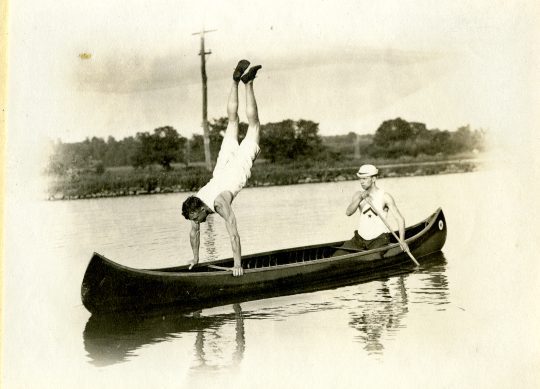
In 1911 and again in 1913, H.D. Cranston and E.C. Sanders, quoted above, set out from Schenectady to explore the wilderness of New York state. Both men were engineers at General Electric, Sanders as an engineer and executive editor of the General Electric Review, chronicling the history of the electrical revolution at the company.
The two travel accounts they created, including typewritten journaled pages and photographs, are a fascinating glimpse into not only their personal experiences, but the way the Adirondacks were experienced by many visitors in the early 20th century. The Adirondack Park was created in just 20 years before the pair’s explorations.
Both accounts remind us of how different and sometimes difficult accessing the North Country was at the time. Among the many strong opinions expressed in their stories, they have a firm conviction in the superiority of trollies, “our fair goddess electricity” (2400 volts not 600, obviously!), over trains, “the vile steam monsters.”
The 1911 journal recounts a canoe trip in two legs, the first left from Old Forge, rowed the Fulton Chain and beyond to Upper Saranac Lake. The second began on Lake Champlain at Fort Henry and ended at Lake George Village. For those who enjoy specs, they paddled a 17-foot White canoe with a Morris yoke for eight days, traveling 135 miles by water, including 17 lakes, and rowed an estimated 47,520 strokes.
The 1913 journal, An Incident in the Lives of Great Men, tells the story of “a jaunt to Glens Falls along the banks of the Hudson.” Cranston, Sanders, and two others spent a day and a half hiking from Saratoga to the center of town in Glens Falls, “startling its inhabitants as we entered.”
The journals clearly express the travelers’ excitement at the challenges they’d set for themselves, their sense of adventure and competition, their pride in their accomplishment and, perhaps most profoundly, their sense of wonder and awe in the natural beauty at their doorsteps.
It’s been over 100 years since they completed their last “historette punched out one letter at a time.” But their tales of kneeling in a canoe doused in water; wringing out dripping wet clothes; meeting local innkeepers (and their dogs, many welcoming but some less so); and the constant obsession with what’s to eat, are not so different from the way many of us enjoy the Adirondacks today.
The E.C. Sanders and H.D. Cranston Travel Accounts have been digitized and are available from the Union College digital repository, ARCHES. The originals are available upon request in the Adirondack Research Library at the Kelly Adirondack Center of Union College.
Photo at top courtesy of Adirondack Research Library.
Thanks to Margie Amodeo for adding interesting details about some of people who shaped the Adirondack region as it evolved over the decades.
From the early 1800s, as a valuable timber source plundered for profit, the Adirondack region is today, world-renowned for its all-season outdoor recreation, and for the restorative benefits its abunant nature offers us.
Many people have taken part in the work to preserve the Adirondacks as a “forever wild” refuge for the benefit and enjoyment of all. Many more will be needed to continue that work in the future.
Many of the strongest Adirondack advocates of the last century discovered their love of this region while working with like minded people at the the General Electric Company in Schenectady. I can only imagine what the synergy must have been like to be sharing ideas with John Apperson, Irving Langmuir, members of the Schaefer family and so many others as they strategized on behalf of the Adirondack Park.
They truly did set the bar high for all of us who care about this special place.
This is a very interesting article, but I have one complaint.
In modern usage (I don’t know about 1913) the verbs “row” and “paddle” are NOT interchangeable. Rowing requires one or more oars, and oars require a pivot point on the boat, i.e. an oarlock, thole pin, etc.
A paddle, on the other hand, is completely free of attachment to the boat, and is only in the two hands of the user.
Worth inspired me to find a 1900 era dictionary, resulting in: “https://www.websters1913.com/words/”, which confirmed his suspicion. However, if I were Margie sitting at my favorite seat at my favorite bar and Worth started picking apart my word usage, there would certainly be a row which would result in a paddling.
Bill, I wanted to offer a complaint but I did NOT want to be offensive about it!
So maybe I can escape the row and the paddling?
I had better honor your request oar Ms Hart may paddle me. By the way, what was this article about, anyway?
Either way, please hold the paddle correctly!
Although I am familiar with Fort William Henry in Lake George Village, on Lake George, I cannot find any information about a Fort Henry on Lake Champlain. I do know of a Fort Henry in Kingston, Ontario. Can anyone enlighten me about a Fort Henry on Lake Champlain?