

Another intense storm is predicted for tomorrow, May 27, with thunderstorms, high winds, hail…and who knows what else. The mid-west has been hammered for the last week as these storms rolled across the country, one after the other. Tornadoes have hit several towns and villages in their path with some loss of life, and many homes and businesses destroyed. To look at the pictures of the damage, it is amazing that more people hadn’t been killed.
We had some pretty high winds a couple times and with the trees all leafed out, they blow over much more than in the wintertime when they are bare of leaves. On the other hand, the evergreens take it in the shorts in all seasons. I’ve seen where lots of them have been blown down during the winter and now the cleanup has begun. I’ve been meaning to mention that if you have a row of evergreens in your yard and one dies, it should be removed so that whatever killed it doesn’t spread to the others. If left in place, it may spread to the whole row of trees as I have seen happen many times.
The fires in western Canada, mostly in British Columbia and Alberta, have driven thousands from their homes as the wind-driven fires keep moving. Hundreds of residents in four neighborhoods in the southern end of Canada’s oil sand hub of Fort McMurray, Alberta, were ordered to evacuate with a wildfire threatening the community.
Fort McMurray has a population of 68,000 and a wildfire in 2016 destroyed 2,400 homes and forced more than 80,000 people to flee. More than 230 wildfires were burning across western Canada, most of them in British Columbia where about 130 were counted. The smoke from these fires is again blowing easterly and into the US, affecting some major cities as it did last summer from the big fires in Canada.
We had a few more power flashes during the last week and a few lines were blown down, causing minor fires in the area. I don’t know if you have been reading about the major power transmission line going from Canada to New York City. From Canada it is going under the length of Lake Champlain and south from there. I looked up how long the lake is, and I got two different figures, one was 107 and the other was 120. The other difference was in the width, one stated it was fourteen miles wide and the other said it was twelve miles wide. Both agreed it was four hundred feet deep at the deepest point.

If they can lay a cable under Lake Champlain and on to New York City (as I haven’t seen the rest of the route, if it is above ground from there or underground and some water from there.) Why can’t they lay an underground line from Inlet to Raquette Lake where they had
proposed the big Lithium Battery storage units to keep Raquette Lake powered up? For that matter, put it underground from wherever to here and eliminate all the power outages from trees and vehicles taking down the poles and the lines.
I’ve heard the power company people say it would lose too much power underground, so how much power is lost when you put it under water for 120 miles (and maybe more) before it gets to New York City? These tree service companies might be out of business in this neck of the woods, but there certainly are places around the country where these storms are hitting that could use a lot of help.
When I was growing up, the federal government built a high-tension line right over our two-acre garden. If you walked under that line while working in the garden, it would feel like it would make your hair stand on end. They cut the big pine trees and a large elm tree from our property, but I was able to keep my pigeon coop because it was less than twelve feet high. The pigeons never had successful nesting after that power was turned on. Instead, babies were deformed, or eggs never hatched, and I didn’t connect it to the power line until later.
My grandparents, whose trailer was near the pigeon coop, both died of cancer as did my dad who spent much of his spare time working in the garden under the line. A neighbor who lived across the road whose house was right parallel to the line also died of cancer. If you walk under one of these big high-tension lines today, you can feel the activity. I am sure I will get some comments, but these are hard facts that happened in my life.
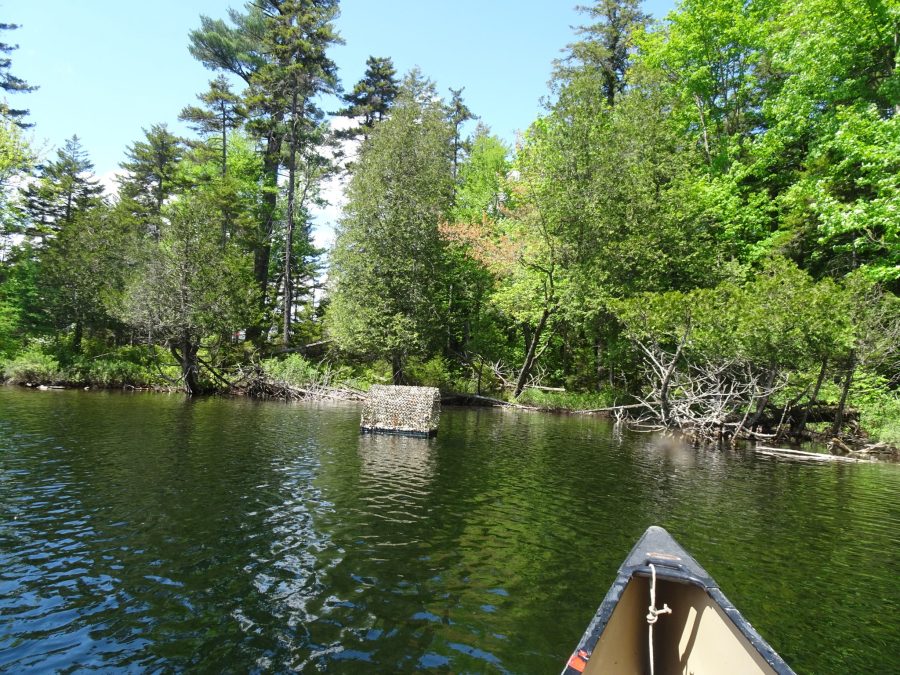
Loons are nesting early, and you may see some of the loon nesting platforms on area lakes put out by the Adirondack Center for Loon Conservation. If you see a loon on a nest, take your photos from a distance and not with your cell phone at five feet away. Many wildflowers are blooming, with many pink lady’s slippers out in the area. Please just take a picture and leave them to have many seeds so more may grow.
The black flies are out, so be prepared if you are out and about, but that’s another story. See ya.
Photo at top: New loon platform on the water. Photo by Gary Lee.
Hi Gary, thank you for the personal story that goes with the transmission lines. 1) We are off-grid here in Indian Lake, so the “transmission line” is about 100′ from the panels to the batteries.
2) First law of thermodynamics: energy can neither be created nor destroyed. If the line is losing power underground, or under water, where is that power being “lost” to? 3) This power COMES FROM somewhere, I believe James Bay, and there are serious social and environmental consequences that come from the hydro dam there. Thanks for adding your voice to the conversation.
The Lake Champlain power line is a DC power line, designed for underwater use. The don’t use A.C. for this due to (I believe) inductive line loss. Laying any power cable under the ground is extremely more expensive than under water, due to the obstacles encountered, need for easements over private properties, road crossings, cost to dig and restore, etc…. is why most high power electrical transmission is overhead, even though it is more vulnerable to damage in storms. Think back on the huge ice storm that hit Quebec many years ago and totaled miles of high tension power, leaving a million without power in winter. They did not replace with buried power line, they made the replacement above ground more robust. There are likely many sections of the ADK power distribution that should be buried, state priorities say they would rather spend $850 million of tax payers money on a football stadium in Buffalo.
Thanks Gary, for sharing that powerful memory of how project oversight failures can come back to hurt us. A lot of people level complaints against the APA and DEC for such failures. Your story exposes another frequently heard citizen complaint about the arbitrary nature of power line route selection over private property. That siting of high tension power lines over your family’s garden changed the lives and health of you, your relatives, and probably many others as well.
Your story made me think back to an oversight horror from my own childhood summers. Back then the kids thought it was great fun to run and ride bikes behind the “mosquito control” jeep that periodically sprayed a dense white fog of DDT all around the county. Oversight? I’m guessing none – except the worry that a kid might fall off a bike in that dense fog. Back then, nobody seemed worried that the widespread use of DDT might cause health problems, or devastate our natural ecosystems the way they did.
Many years later, at Paul Smith’s College, our class was attending a maple syrup workshop at the Grange Hall near Malone. The sales rep. from a well known chemical company had just given us a pep talk about the company’s exciting new formaldehyde pills. They could be inserted behind each spile to increase sap flow. This use sounded a bit strange to me.
After he finished pitching his product, the salesman launched into a vicious attack demeaning a woman that I had never even heard of. Her name was Rachel Carson, and, as I quickly learned, she had written a book about the chemical industry that sounded like it might be worth reading. The title of her book was “Silent Spring”!
In retrospect, I realize that this was a coming-of-age moment for me, when I began to see a darker side to our ideal of an “American Dream”, with opportunity for all. This darker side venerates an unfettered and under-regulated, money driven corporate culture above all. Many more such moments lay ahead.
Gary,
About a quarter of the Champlain Hudson Power Express (CHPE) will not be immersed in the Hudson River or Lake Champlain. The very high cost of line burial is clearly visible along the shoulder of Rt 22 between Whitehall and Ticonderoga where burial is requiring extensive blasting of ledge rock, not just digging a ditch. Lots of traffic interruptions.
So writing this because spreading a falsehood never works out well for everyone. There has never been any proven evidence of getting cancer living near high voltage lines. Yes it may interrupt some magnetic fields but it does not outright cause cancer. Before you post language like that make sure you have 100% proof there of.
Here is what the American Cancer Society has to say:
———-
Several national and international agencies study different exposures in the environment to determine if they can cause cancer. Something that causes cancer or helps cancer grow is called a carcinogen. The American Cancer Society looks to these organizations to evaluate the risks based on evidence from laboratory, animal, and human research studies.
Based on animal and human evidence like the examples above, some expert agencies have evaluated the potential cancer-causing nature of ELF radiation.
The International Agency for Research on Cancer (IARC) is part of the World Health Organization (WHO). One of its major goals is to identify causes of cancer. In 2002, IARC considered the evidence for ELF magnetic and electric fields separately:
It found “limited evidence” in humans for the carcinogenicity of ELF magnetic fields in relation to childhood leukemia, with “inadequate evidence” in relation to all other cancers. It found “inadequate evidence” for the carcinogenicity of ELF magnetic fields based on studies in lab animals.
It found “inadequate evidence” for the carcinogenicity of ELF electric fields in humans.
Based on this assessment, IARC has classified ELF magnetic fields as “possibly carcinogenic to humans.” It has classified ELF electric fields as “not classifiable as to their carcinogenicity to humans.”
In 1999, the US National Institute of Environmental Health Sciences (NIEHS) described the scientific evidence suggesting that ELF exposure poses a health risk as “weak,” but noted that it cannot be recognized as entirely safe, and considered it to be a “possible” human carcinogen.
Between 2011 and 2015, the European research group ARIMMORA (Advanced Research on Interaction Mechanisms of electroMagnetic exposures with Organisms for Risk Assessment) did several studies to look for possible links between ELF-MF and cancer, especially childhood leukemia. The project concluded that their studies were consistent with the previously established IARC classification of ELF-MF as “possibly carcinogenic.”
So based on all the evidence to date, there is no positive evidence that it is carcinogenic. Nothing can be classified as entirely safe. What you run into here is the possibility that, rather than a scientist making the determination, you get a jury of non-scientists making the determination. That is what happened with Roundup (Glyphosate). All the scientific evidence showed that it was perfectly safe for humans that way it was (and still is) being used, yet a jury awarded billions of dollars anyway – so now everyone thinks it isn’t safe. If you give a lab rat enough water you will kill it, but guess what – water is safe..
“f they can lay a cable under Lake Champlain and on to New York City (as I haven’t seen the rest of the route, if it is above ground from there or underground and some water from there.) Why can’t they lay an underground line from Inlet to Raquette Lake where they had
proposed the big Lithium Battery storage units to keep Raquette Lake powered up? For that matter, put it underground from wherever to here and eliminate all the power outages from trees and vehicles taking down the poles and the lines.”
Probably because it is easy to lay a cable under water, and there are pre-existing tunnels that could run cable down to NYC.
Burying cable in the Adirondacks given it’s geology is impossibly expensive I would guess. We do have lots of underwater cables in places which are great (like a camp I have for example). And so much less ugly than poles.
Gary,
Since you mentioned the Fort McMurray fire in Alberta, I think you and Karen would enjoy the award-winning book FIRE WEATHER by Canadian author John Vallant. It’s not only about the Fort McMurray fire, but how the nature of fires has evolved in what he calls the Petrocene (Fossil Fuel) age. It’s nonfiction but reads as a captivating novel — fascinating but a bit scary, too.
Glad to see the ladyslippers!!
Best,
Mary Ann (Mathers) Simmons (Limekiln Lake)
Those big lines are definitely an environmental problem . More honest studies needed!
HI, Can you tell me where Remsen Bog is? Thanks