


Piling up the salt
Statewide contracts managed through the Office of General Services lower the price and streamlines the purchase of commodities like fuel, milk and, of course, road salt.
A half-dozen suppliers accounted for more than $850 million in salt purchases statewide the past five years under the OGS contract, according to state records.
American Rock Salt in Mount Morris near Rochester and Minnesota’s Cargill supplied nearly three-quarters of all salt ordered by state agencies, local governments and other users under OGS’s buying agreement.
The vast quantities of salt that can be purchased at those rates — on average 2.7 million tons each of the past fives years — helps keep society humming along the state’s byways and highways. It also continues to accumulate in soil, groundwater and surface water — the water we count on for drinking and sustaining aquatic life.
I wrote about the statewide road salt contract for our latest magazine issue, while also digging into the Adirondack Road Salt Reduction Task Force and where that high salt use has started to penetrate public drinking supplies. Those stories are now online for all to read.
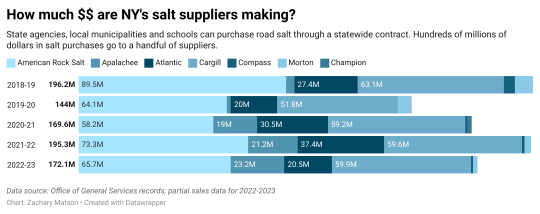
Click here for an interactive version of the above image.
WHAT’S NEXT FOR ROAD SALT: With a panel of task force members and other experts, the Adirondack Explorer will examine what’s in the road salt task force report, how to carry out its recommendations and the latest in the long-running movement to combat road salt pollution in the park. JOIN US FEB. 15
More hydropower?
Researchers at the Idaho and Pacific Northwest national laboratories crunched data and mapped dams not currently used for hydropower with potential to produce power.
The project developed a prioritization tool that evaluated traits of 80,000 so-called “non-powered dams,” identifying around 500 nationwide “as having the potential to add hydropower generation.”
Of the hundreds of Adirondack dams that don’t generate electricity, the researchers found just two they deemed viable candidates: Indian Lake Stone Dam and Starbuckville Dam on the Schroon River.
Indian Lake Stone Dam already has a long history of being considered for hydropower generation, but its forest preserve status and the logistics of conversion have so far complicated efforts. As the Hudson River-Black River Regulation District, which owns the structure, developed renovation plans this years, some residents called for installing power generation. The state agency was focused on the dam’s needed structural and operational improvements and did not consider adding power generation.
Interestingly, the researchers also listed about a dozen lock dams on the Erie Canal that have the potential to add to the state’s renewable energy mix.

Photo at top: The dome structure covers a salt pile at a state Department of Transportation facility on Route 3 near Harrisville. Photo by Stephanie Tartakoff/Explorer file photo.
This first appeared in Zach’s weekly “Water Line” newsletter. Click here to sign up.
Thank you for this important article, Zach. Follow the money.
In addition to fouling the water supply, excessive road salt also quickly rusts vehicles, leading to their early repair and retirement costing taxpayers billions.
I think your story is misguided. First of all, it isn’t how much $$ companies selling sale made, it was how much they sold form being ordered from a contract the state has in place. It would be like saying Ford was responsible if drunk driver killed someone driving a Ford, Go after the authority that allows salt being used on the roads and see what the other solutions are. That’s the issue at hand and how I suggest you approach it. Show us the alternatives and not a deep dive into each company and their sales by year.
Bill K.,
This article is just part of an ongoing examination of the subject – often requested by commentators. Do a quick search on this site and Adirondack Explorer and you will find other articles regarding additional aspects of the issue being examined by the author and others.
Thanks. Looks like others agree with your approach. I’ll watch and see how it gets resolved following the money.
The NYS government not being held accountable for any of their actions. Just those evil capitalst corporations selling their product to them are responsible. Extortion.
Follow the money… or as was one said, the business of America is business!
Happy holidays
I guess one might say there is one plus. It appears the salt is coming from NY mines.
Also, we’ve heard very little about the benefits of salt vs brines for our highways. Of course cost of conversion of equipment is a factor. Yet a brief search indicates the cost per mile show brining is cheaper.