
 November 11, 2014 marked the 220th year of the Canandaigua Treaty, which was signed in 1794 by United States representative Colonel Timothy Pickering, and leaders of the Haudenosaunee Nations: the Seneca, Cayuga, Onondaga, Oneida, Mohawk, and Tuscarora. The Canandaigua Treaty established peace, friendship, and respect between the Nations and the United States.
Each year leaders of these Sovereign Nations and others remembering and honoring the treaty meet at the original site of the treaty’s signing, a place called Council Rock. Council Rock sits on the front lawn of the Ontario County Courthouse on Main Street in Canandaigua, NY.
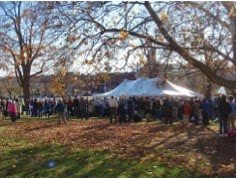
The treaty brought about peace between the Haudenosaunee Nations and the United States, and “recognized the sovereignty of the Nations to govern and set laws as individual nations.” In the image above Peter Jemison site manager of the Ganondagan State Historic Site, explains the history and context of the treaty signing to those assembled at the Council Rock. The Friends of Ganondagan, a non-profit group, organizes the treaty day each year.
 The annual meeting in Canandaigua, NY follows the counsel of the renowned Seneca Chief Red Jacket, a Haudenosaunee leader present at the treaty signing in 1794, who explained that the “business of this treaty is to brighten (polish or care for) the chain of friendship.”[The links of a chain can become deteriorated by neglect over time. The “chain of friendship” is illustrated in a wampum belt presented at the 1794 treaty signing to the Haudenosaunee Nations on behalf of George Washington and the United States.
A wampum belt is a wide patterned belt made from a combination of purple or white mollusk shell beads. The belts or patterns of beads represent a formal agreement, law, position, or message. Peter Jemison describes the purpose of the belts “… as a mnemonic device for remembering important ideas, so that when the reader of the belt holds it in his hands, the idea literally comes from the belt.” The belt given by George Washington to the Haudenosaunee Nations represented the United States’ understanding of the Canandaigua Treaty.
The full belt illustrates fifteen linked human figures and a house at the center. Thirteen figures represent the thirteen colonies of the United States at the time, and the two figures and the house at the center represent the Haudenosaunee Nations. In the Washington belt image below the figure on the left of the longhouse represents the Seneca Nation, which inhabits the western door of the longhouse, and the figure on the right represents the Mohawk Nation, which inhabits the eastern door of the longhouse. The longhouse represents the territory of the Haudenosaunee Nations, which stretches from east to west with the Onondaga Nation in the center.


How good of you to write this and help others to know about Treaty Day, and the grand significance thereof. Thank you.
Leaders from far and wide should read your well-written article, which has many lessons to be learned to this day!